


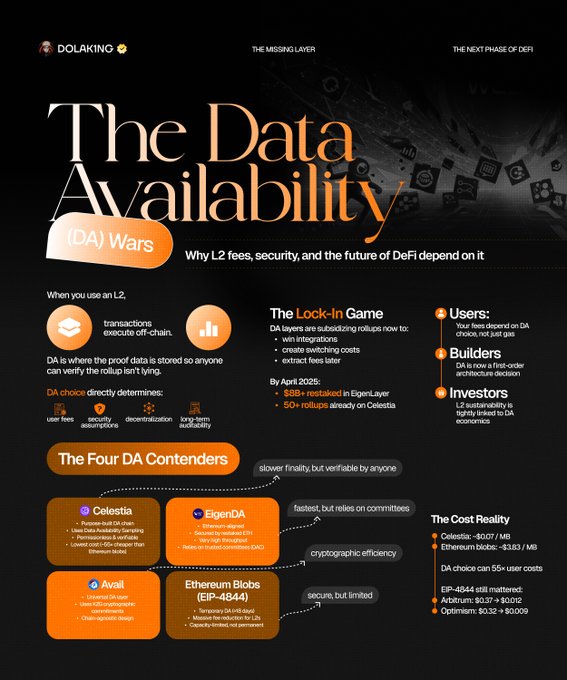
Celestia, EigenDA, Avail, Ethereum blobs You keep hearing these names but nobody explains why they matter. Here's the truth: DA layers are the hidden backbone of every L2 you use, and choosing wrong can 55x your costs." Let me explain how 🧵👇 Every time you swap on Base, trade perps on Arbitrum, or bridge to Starknet, something happens in the background that determines how much you pay. It's called Data Availability. And right now, a silent war is being waged over who controls it. The Problem Nobody Explains When you execute a transaction on a Layer 2 rollup, where does the proof actually live? Rollups work by executing transactions off-chain and posting compressed proofs back to a base layer. But that proof data needs to be stored somewhere accessible so anyone can verify the rollup isn't lying about your balances. This "somewhere" is the Data Availability layer. For years, the only option was Ethereum itself. The problem? Ethereum storage is expensive. Before March 2024, rollups spent over 15,000 ETH, roughly $34 million writing data to Ethereum in December 2023 alone. Those costs passed directly to users through transaction fees. Something had to change. ➥ The Four Players at War Today, four major players are fighting to become the DA layer of choice: ► @celestia : A purpose-built blockchain that does nothing but data availability. No smart contracts, no execution. Uses Data Availability Sampling that lets lightweight nodes verify data without downloading everything. ► @eigen_da : The Ethereum-native challenger. Built on EigenLayer's restaking infrastructure, it lets Ethereum validators "re-stake" their ETH to secure data availability. The pitch: inherit Ethereum's economic security without building a new validator set. ► @AvailProject : The universal layer. Originally incubated by @0xPolygon but designed for any blockchain ecosystem. Uses KZG cryptographic commitments for compact, verifiable data storage. ► Ethereum Blobs: The incumbent's response. EIP-4844 introduced "blob transactions", temporary data packets pruned after about 18 days. Cheaper than permanent calldata, but with limits. Each represents a different philosophy about where trust should live in a multi-chain world. ➥ The Numbers That Matter Cost is the most obvious battlefield. @EclipseFND posts data to @celestia at approximately $0.07 per megabyte versus $3.83 per megabyte for Ethereum blobs. That's Celestia being over 55 times more cost-effective. But Ethereum's blob upgrade was still transformative. After EIP-4844, Arbitrum fees dropped from $0.37 to $0.012. Optimism fell from $0.32 to $0.009. L2s finally felt genuinely cheap. Throughput tells another story. EigenDA claims 100 MB/s on mainnet. Celestia runs around 1.33 MB/s with 8MB blocks. Avail operates at roughly 0.2 MB/s. Raw speed favors EigenDA. But speed isn't everything. ➥ The Trust Tradeoff Nobody Mentions Here's what most DA analysis skips: faster solutions often achieve speed by introducing trust assumptions that undermine decentralization. @eigen_da is a Data Availability Committee (DAC), not a publicly verified blockchain. Operators form a trusted committee who promise to make data available, but end users have no way of independently verifying this. The only guarantee is economic, the risk of slashing. @celestia takes the opposite approach. Its sampling technique allows resource-constrained nodes to probabilistically verify data availability. Security actually gets stronger as more nodes participate. But finality takes longer around 10 minutes versus near-instant for DACs. The decentralization metrics reflect this. Celestia runs 100 validators with a Nakamoto Coefficient of 6. That's verifiable and permissionless. @eigen_da committee structure, while economically secured, doesn't offer the same independent verification. This matters because blockchain's value proposition is removing trust. If your DA layer requires trusting a committee, you've reintroduced what you were trying to eliminate. The Hidden Danger: Data Persistence One risk that never appears in DA comparisons: what happens to historical data over time? Consider a rollup launching on Celestia, operating for two years, then migrating to EigenDA. What happens to those first two years of transaction history? If Celestia nodes stop storing that data, can anyone verify the rollup's historical state? Ethereum blobs explicitly don't solve this, they're designed for temporary availability (18 days). Celestia and Avail have longer retention but no permanent guarantees. For DeFi, this matters because financial systems require auditability. If you can't prove what happened two years ago, you can't resolve disputes or verify historical claims. The DA layer you choose today has implications for verifiability years from now. The Economics of Lock-In DA layers offer subsidies, favorable fee structures, and ecosystem grants to attract rollups. Celestia has built deep integrations with OP Stack, Arbitrum Orbit, and Polygon CDK, resulting in over 50 rollups using Celestia, including @MantaNetwork and @plumenetwork. EigenDA plays the Ethereum alignment card. For rollups wanting to stay close to Ethereum's security model, restaked ETH is attractive. Celo and Mantle have signed on. The long game is clear: today's subsidized onboarding becomes tomorrow's fee extraction once switching costs are high enough. By April 2025, EigenLayer accumulated approximately $8 billion in restaked assets, serious money positioning for a future where DA fees flow to whoever controls this layer. The Market Nobody's Pricing In Analysts project the DA sector growing from $2 billion in 2024 to $22 billion by 2030 a 45% CAGR. By the end of 2025, DA layers are expected to support 80% of Layer 2 activity. The cost structure of the entire L2 ecosystem All DeFi, gaming, and consumer apps will be determined by which DA layers win and what they charge. Yet almost no one in the broader community is paying attention while the infrastructure battle plays out. ➥ What This Means For You → If you're a DeFi user: Your fees are tied to which DA layer your rollup chose and you probably don't know which one. Lower fees don't mean better security; often it's the opposite. → If you're building: DA choice is now a first-order architecture decision affecting cost structure, security model, and long-term verifiability. Vendor lock-in is real. Plan for optionality. → If you're investing: Understanding DA economics helps evaluate L2 tokens a rollup's sustainability depends heavily on DA costs. In summary, whoever wins will control the cost structure of the entire L2 ecosystem for the next decade. They'll determine whether rollup fees stay cheap or creep back up. They'll shape whether the modular thesis delivers on its promise. The real alpha is understanding the infrastructure that makes everything else possible.

From Twitter
Disclaimer: The content above is only the author's opinion which does not represent any position of Followin, and is not intended as, and shall not be understood or construed as, investment advice from Followin.
Like
Add to Favorites
Comments
Share
Relevant content


