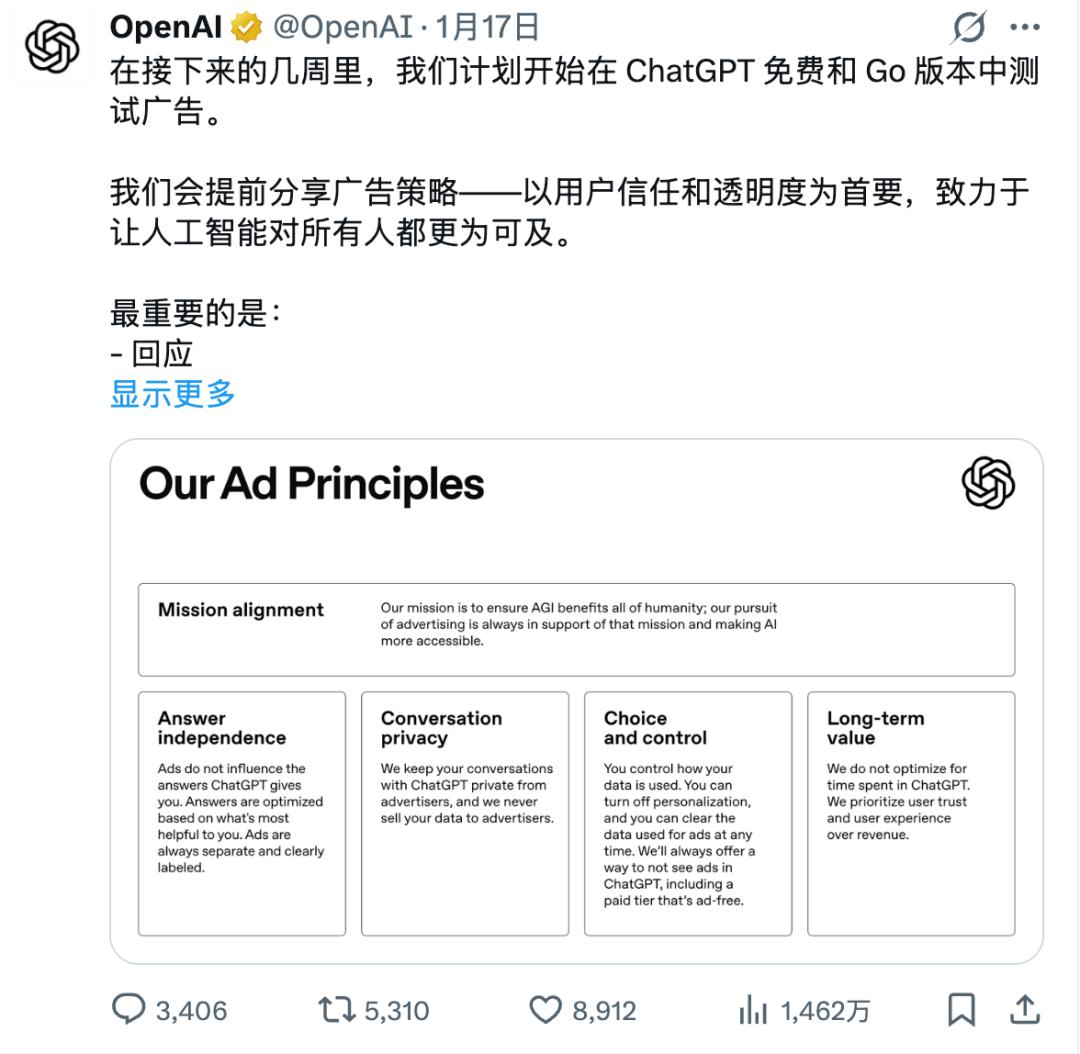
The shoe has finally dropped: OpenAI has announced the launch of ads in ChatGPT.
According to the official OpenAI blog, the ads are targeted at free users and Go subscription users—Go is a newly launched subscription plan that costs $8 per month, while Plus, Pro, Business, and Enterprise users will not see the ads.
I wrote an article last April specifically about "Why is advertising the most realistic business model for AI large-scale model companies?"
These findings are now being verified one by one. While the discussion is still fresh, and combining my previous points, I'd like to share five reflections—
Reflection 1: The fact that the advertisement was launched a month after the company released Code Red indicates that OpenAI's product development and commercialization are at odds.
In early December last year, due to the impact of the Gemini 3 Pro, Sam Altman issued a code red alert internally, saying that the entire company should focus on improving ChatGPT and put other projects, including advertising, on hold.
The final result was that the ads were launched after only a little over a month's delay, which only shows that the pressure to monetize was too great, so great that they had to make a living from advertising as soon as possible.
Last August, OpenAI poached Fidji Simo to serve as CEO of its application business. She was previously an executive at Meta, where she was in charge of Facebook’s advertising business, and later became CEO of Instacart.
In addition, many people at OpenAI previously worked in advertising. For example, Kevin Weir, the current Chief Product Officer at OpenAI, previously had a key role at Instagram in overseeing advertising on Instagram.
Another vice president, Shivakumar, joined in May 2024. His previous job was as the head of Google's search advertising division.
Take a closer look at these people's resumes.
Clearly, these people weren't there to conduct AGI research; their sole objective was to make money.
Advertising is the fastest and most direct way to make money.
The involvement of these individuals psychologically altered Sam Altman's attitude towards advertising.
Let's examine how this change specifically occurs—
In May 2024, Ultraman said in an interview:
"The combination of advertising and AI makes me particularly uneasy. I believe that advertising is the last resort in our business model."
The original quote is:
“Ads plus AI is sort of uniquely unsettling to me. I kind of think of ads as a last resort for us for a business model.”
By his 2024 Harvard speech, his tone had softened somewhat:
“I personally hate advertising, but I’m not completely against it. I’m not saying OpenAI will never consider advertising.”
In a March 2015 interview with technology writer Ben Thompson, when discussing business models, he stated—
“I’m not against advertising, and I won’t be stubborn if there’s a good reason to do it. I’m more interested in trying new models, such as charging a 2% marketing commission for users who find products they want to buy through ‘in-depth research’.”
In October 2025, he said in a podcast:
“I love Instagram ads; they’ve given me value, helped me discover things I’d never seen before, and I’ve bought a lot of great stuff. I believe we might be able to create some really cool ad product that’s a net benefit for users.”
The process of Ultraman being proven wrong precisely demonstrates that he is a pragmatist, and the launch of the Code Red advertisement a month later also indicates that commercialization, application, and research are already showing signs of conflicting with each other.
How to walk a tightrope between these three factors is Ultraman's biggest challenge going forward.
Second point of reflection: OpenAI seems very cautious in terms of its advertising format, but I have a bold theory: this caution may not last long.
Based on the information released so far, OpenAI is still quite cautious about advertising:
First, it's crucial that the ad appears at the bottom of the answer, rather than in the middle.
Secondly, advertisements will be clearly marked as "Sponsored," which is distinct from normal answers.
Third, users can choose to turn off personalized ads, understand why they saw a particular ad, or directly close an ad and provide feedback.
OpenAI specifically states: Advertisements will not affect the content of ChatGPT's answers.
These designs suggest that OpenAI, as a newcomer to advertising, doesn't want to take too big a step.
But the question is, how long can this cautious state last?
In fact, The Information reported last December that OpenAI had internally discussed a plan to allow AI models to "prioritize displaying sponsored content".
Although it wasn't implemented, the fact that the idea was seriously considered speaks volumes.
Google did the same thing back then. Initially, ads were placed on the right side of the search results, completely separate and distinct from them.
What happened next?
Therefore, it is difficult to resist the temptation of commercialization, especially considering that it burns through $17 billion every year.
I just hope OpenAI won't be even more greedy than Google.
OpenAI says they will not sell conversation data to advertisers, and users can clear data used for advertising at any time.
I find this hard to believe, after all, Facebook said the same thing back then, and we all know what happened afterward.
Don't overestimate the moral standards of these American capitalists; the only thing that can restrain their behavior is the competitive landscape.
Emarketer analyst Jeremy Goldman's comments are representative:
“If the ads appear clumsy or opportunistic, users can easily switch to competitors, such as Google’s Gemini or Anthropic’s Claude.”
Third point of consideration: Should Google be happy or worried?
There is disagreement in the industry regarding the impact on Google, with two main viewpoints—
One side believes that Google must be losing sleep.
The reason is that if an app with 800 million weekly active users adds ads, it will obviously take away the advertising share from the ads.
Google's advertising revenue alone is projected to reach $74.2 billion in the third quarter of 2025, with YouTube contributing another $10.2 billion. This is Google's strength and its lifeline.
If ChatGPT can prove that conversational advertising has a higher ROI than search advertising, then Google certainly has a reason to lose sleep.
This is a straightforward logic; let's look at the other side's perspective—
Some analysts believe that Google may not be worried.
The reason is that Google's biggest fear is that OpenAI will actually create a pure, detached product that completely shifts user habits from search to conversation, and that it will not monetize through advertising at all.
In that case, Google's foundation—advertising revenue—would be completely undermined; that would be a devastating blow.
Now, OpenAI is advertising too.
This means the battle has returned to Google's most familiar battlefield: Whose advertising system is more efficient? Who has more advertiser resources? Who has a higher CPM?
In this respect, Google is the pioneer, while OpenAI is still a newcomer.
In a sense, I agree with the latter viewpoint.
Once OpenAI starts relying on advertising revenue, it will inevitably become more and more like Google, having to appease advertisers, track data, and comply with regulations.
It will become heavy and vulgar.
At this point, even if Google's Gemini only achieves 90% of the user experience of ChatGPT, it can thrive thanks to the Android ecosystem and its massive advertising sales network.
OpenAI has brought itself back to reality, so Google is no longer afraid.
Don't forget, Gemini has already caught up technically. If OpenAI's advertising model proves to be viable, then adding Gemini to advertising will be a piece of cake.
Question 4: How much money can OpenAI make from advertising in a year?
This estimation is actually quite difficult.
If we use the classic advertising formula below to calculate, we will face the dilemma of not knowing where to start with many factors—
Revenue = Daily active free users × Average number of sessions per user × Ad load rate × Click-through rate (CTR) × Cost per click (CPC) × 365 days.
For example, there's no readily available data on the average number of sessions per user, so how do you calculate ad load rate? Click-through rate (CTR) and CPC are even more difficult to calculate. Even if you calculate CPM together, it's hard to directly refer to Google's CPM, since ChatGPT was only launched in the US in its first year, while Google's data is usually global.
So, let's make predictions from two other simpler ones—
Let's look at the first algorithm: Revenue = Number of users × ARPU
First, let's look at the user base. ChatGPT currently has 800 million weekly active users, of which about 95% are free users, meaning that 760 million people may see the ads.
However, the advertising was initially tested only in the United States, where users account for about 19%, or 140 million people. It was only open to adults, so let's say we have 100 million users.
Next, let's look at ARPU (Average Revenue Per User).
Referring to Google, its global advertising ARPU is about $50 per year, and as high as $200 per year in North America. However, ChatGPT is a new advertising platform, and its advertising ad load, advertising bidding queue, and advertising system infrastructure efficiency will be far lower than Google's.
So let's assume that ChatGPT's first-year advertising ARPU is 10%-20% of Google's, which is between $20 and $40.
Calculation result: 100 million users × $20 / $40 = $2 billion / $4 billion.
Is this number reasonable?
In comparison: OpenAI's total revenue in 2025 is about $20 billion. If advertising contributes $2-4 billion next year, that's about 10-20% of this year's revenue. As a new business line, the starting figure is quite considerable.
Let's look at the second algorithm: It's modeled after Google search ads.
According to publicly available information, Google Search currently handles approximately 14 billion queries per day, and its search advertising revenue is projected to reach approximately $200 billion by 2025. ChatGPT currently processes approximately 2.5 billion messages per day, equivalent to 18% of Google's query volume.
However, it cannot be calculated simply by proportion.
There are three reasons:
First, the conversational nature of ChatGPT means that the frequency of ad display is much lower than that of search—Google has ad placements for almost every search, while ChatGPT only displays ads after some of the answers;
Second, ChatGPT's proportion of business intent queries is likely lower than Google's, with about 30% being work-related and many conversations being casual chat.
Third, advertisers are still in a wait-and-see period regarding AI advertising, and the CPM (cost per thousand impressions) will be lower than that of mature search advertising.
Taking all the above factors into account, we assume that the effective monetization rate of ChatGPT ads is 10%-20% of that of Google.
Calculation result: 200 billion × 18% × 10%/20% = 3.6 billion USD / 7.2 billion USD.
The results from the two methods are not significantly different. ChatGPT's advertising revenue in its first year was estimated to be between $2 billion and $7.2 billion, which is already quite substantial.
This money can help alleviate OpenAI's cash burn pressure, but it is still a drop in the bucket compared to its $1.4 trillion infrastructure investment commitment.
However, back in Q2 of last year, Wells Fargo Securities analyst Ken Gawrelski gave a bold prediction in a report: ChatGPT's advertising revenue could reach $100 billion by 2030, accounting for 30% of the global search advertising market.
I have a wild theory: advertising revenue will most likely become OpenAI's largest source of revenue within three years.
Question 5: When will other AI companies in Silicon Valley and China start advertising?
Many people believe that OpenAI is the first AI company to venture into advertising.
No, many other companies started doing this long ago.
Google introduced ads into its conversational AI products in 2024, but placed them in the AI-generated search results overview.
At Google Marketing Live last May, Google Vice President and General Manager of Advertising, Vidhya Srinivasan, announced the addition of ads to Overviews.
At its December 2024 marketing conference, Baidu also explicitly stated that "AI search results" would be added to its commercial traffic pool.
On November 12, 2024, Perplexity published an article on its official blog titled "Why we're experimenting with advertising," announcing the introduction of advertising.
There are two main forms: one is "related questions after the answer", and the other is advertisements in the sidebar of the answer. Both forms will be marked as "sponsored".
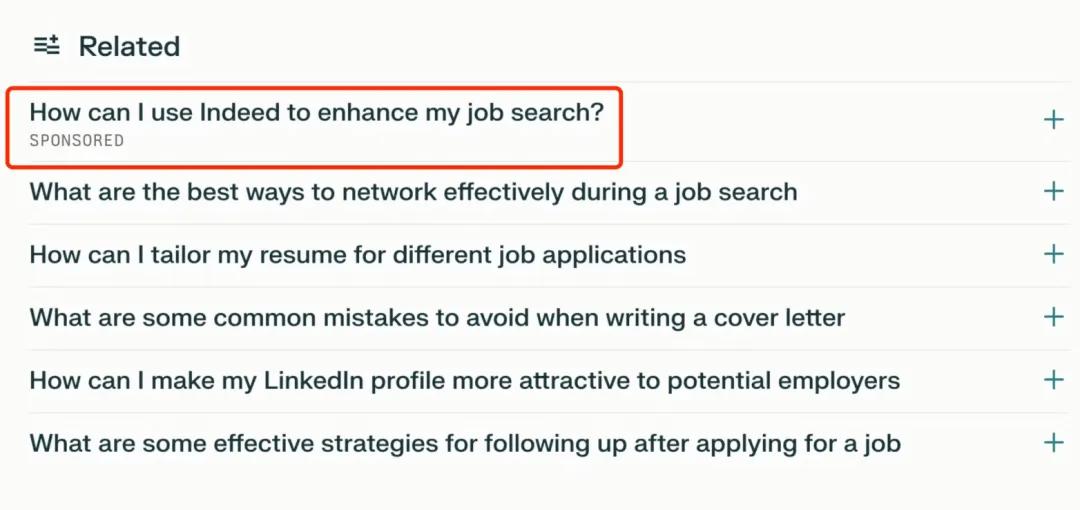

Furthermore, as early as 2023, Microsoft's Bing search had already integrated ads into its AI assistant Copilot, with ads displayed below AI-generated answers and marked "sponsored".
However, most large model products in China do not have ads, so the question is—when will they add them?
I believe happiness will come in the next year or two.
Why do I say that?
I believe the core reason these companies didn't add advertising is not because they didn't realize the efficiency and value of the advertising model.
Instead, they believe that in the early stages of a market where product competition is fierce, there are more important things to do than advertising, and therefore they have not reached a consensus on the timing of introducing advertising.
Of course, the specific circumstances of each company are still different.
Doubao, backed by ByteDance, is essentially an advertising money-printing machine; getting advertising deals is a piece of cake for them.
However, judging from its movements, it is still focusing its efforts on product growth and is also making great efforts to gather people to push for smart SOTA, while looking down on the small amount of advertising revenue from Rendoubao.
Of course, it hasn't been completely inactive. Doubao, with its strong commercial genes, has already been making cautious attempts, incorporating Douyin's product cards into its answer output.

Yuanbao is backed by Tencent and has an extremely mature advertising system. However, it hasn't accepted any offers yet because it's still in the midst of a battle and it's far from being ready for commercialization.
In fact, during Tencent's Q4 earnings call in 2024, when Tencent's Chief Strategy Officer James Mitchell was asked about how Yuanbao would be monetized, his answer was as follows—
"As for how AI will be monetized, time will tell, but I think we've already seen it in the Western world. The first way to monetize is through a subscription model. Then, over time, performance advertising will follow. I think in China, it will start with performance advertising, and then value-added services will follow."
In other words, Tencent's management believes that in China, performance-based advertising is likely to be more practical than subscription-based value-added services.
As for Qianwen, it is currently pursuing product and user growth at an extremely aggressive stage, and it is clear that commercialization is not the top priority at this stage.
Given that Alibaba's advertising infrastructure is undoubtedly among the top tier in China, securing advertising deals should be a simple matter for them.
Considering Qianwen's recent product update that integrates with Alibaba's entire ecosystem, it would be reasonable and seamless to add ads to shopping actions like "Buy me a cup of milk tea" in the future.
Therefore, the reason why domestic products haven't started advertising yet is simply because the competitive landscape isn't stable yet, but it's only a matter of time before it's added.
It's important to understand that the overall willingness to pay in China is significantly lower than in overseas markets, which is why monetization in China must rely on advertising rather than subscriptions.
Dai Yusen of ZhenFund once said something to the effect of, "A large model is like a high school student right now. You can force it to make money, but it certainly won't make much. But if you invest in it to complete its doctoral studies, then it can make a lot of money."
I prefer this metaphor—
Now everyone is climbing a giant peach tree, and you can pick peaches along the way.
But everyone's goal now is to climb to the top of the tree, to occupy a more advantageous position to pick the peaches and pick the reddest ones, so they don't have time to pay attention to the "low-hanging fruit" for the time being.
Conclusion
After finishing this article, I was reminded of a quote from Sam Altman in 2024:
"If search engines could provide the best answer, users wouldn't click on ads. The premise for ads is that the product doesn't provide the best answer."
He was criticizing Google's search advertising model at the time.
Now, he himself is about to walk this path.
I hope he still remembers what he said, even though that may be wishful thinking.
This article is from the WeChat public account "Weixi's Guide" (ID: weixizhibei) , authored by Weixi, and published with authorization from 36Kr.