Today (20th), Musk kept his promise and publicly uploaded the recommendation algorithm code "Phoenix" for the X platform to GitHub . In this article, we will use the simplest explanation of the X algorithm to help editors of various platforms understand: How exactly does X decide which posts will be seen by more people?
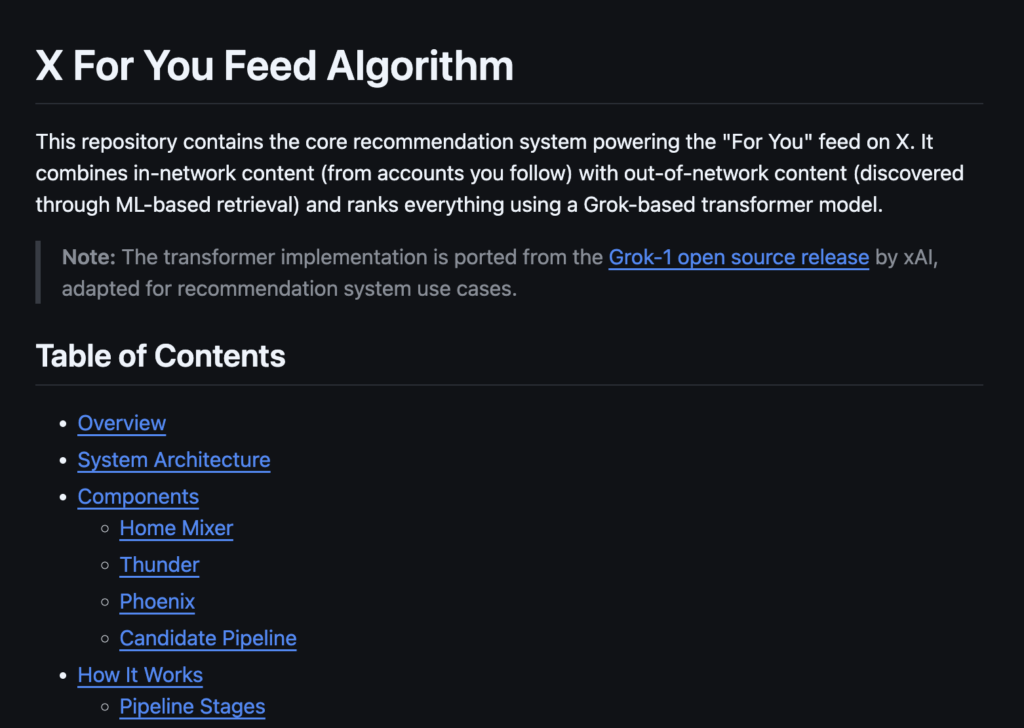
The core concept of the algorithm: two pools
First, it's important to understand that X's "Recommended for You" dynamic wall content comes from two pools:
Pool 1: In-Network (Content within the industry)
- Definition : Posts made by the account you are tracking
- Technology Name : Thunder System
- Features : Instantaneous and low-latency, content can be pushed out almost immediately after it is published.
Pool 2: Out-of-Network (Content Outside the Network)
- Definition : Posts you don't follow, but the algorithm thinks you'll like.
- Technology Name : Phoenix System
- Feature : Mines relevant content from a global post library using AI.
 Key takeaway : Your content won't just be seen by your followers, it might also be recommended to strangers who "might like your content"! This is the key to breaking through your echo chamber.
II. How does the algorithm score posts?
This is the core part. X uses a Grok-based AI model (yes, the same Grok from xAI) to predict the "probability of interaction" for each post.
14 behaviors predicted by the algorithm
| Behavioral types | Chinese explanation | Weighting bias |
|---|---|---|
P(favorite) | probability of liking |  positive positive |
P(reply) | probability of reply | Positive (high weight) |
P(repost) | probability of retweeting | Positive (high weight) |
P(quote) | probability of quoting a tweet | Positive (high weight) |
P(click) | Probability of clicking to expand | positive |
P(profile_click) | Click on your profile picture/personal profile | positive |
P(video_view) | chances of watching a movie | positive |
P(photo_expand) | probability of clicking on the image | positive |
P(share) | probability of sharing | Positive (high weight) |
P(dwell) | Time spent reading | positive |
P(follow_author) | The probability of tracking the author | Positive (high weight) |
P(not_interested) | Click "Not interested" |  negative negative |
P(block_author) | Block the author | Negative (high weight) |
P(mute_author) | Silent author | negative |
P(report) | Report | Negative (high weight) |
Final score formula
Final score = Σ (weight × prediction probability) , in plain language:
- The higher the predictive value of positive behaviors (likes, retweets, replies, shares), the higher the score.
- The higher the predicted value of negative behaviors (blocking, muting, reporting), the more significantly the score drops.
The 6 processing stages of the algorithm
Users open the X icon and proceed as follows: ↓① View user profile (interaction history, follower list) ↓② Source candidate content ( content pulled from Thunder + Phoenix) ↓③ Expand content (supplement post metadata, author information) ↓④ Pre-filter (remove unsuitable content) ↓⑤ AI scoring (Grok model prediction + weight calculation) ↓⑥ Sort selection (highest score displayed at the top) ↓ Presented to the user
What content will be filtered out?
 Pre-filter (deleted before rating).
| Filter | effect |
|---|---|
| Duplicate content | The same content will only appear once. |
| Too old post | Posts that are older than a certain time will not be recommended. |
| My own post | You won't see your own posts in the recommendation feed. |
| Blocked/Mute Accounts | People you block or mute won't appear. |
| Mute keyword | Includes the words you set to mute. |
| Viewed content | I won't recommend things I've already seen. |
| Paywall content | Paid content you haven't subscribed to |
Post-filtering (filtering after scoring)
| Filter | effect |
|---|---|
| illegal content | Spam, violence, pornography, etc. |
| Dialogue repeats | The same discussion thread will not be pushed too many times. |
Two key design concepts
It's entirely determined by AI; there's no "human parameter tuning."
We have completely removed all human-designed features from the system, as well as most of the heuristic algorithms.
X claims they have removed all manually designed feature rules and rely entirely on Grok AI to learn what you like from your interaction history.
What does this mean?
- There is no hard and fast rule about the "best time to post".
- There is no hard rule regarding the "number of hashtags".
- Everything is dynamically learned by AI based on actual interaction data .
Author diversity mechanism
The algorithm has a built-in "Author Diversity Scorer" that reduces the weight of consecutive appearances of the same author.
What does this mean?
- Even if one of your posts goes viral, it won't dominate the entire user's feed.
- Give other creators exposure opportunities
- The editor wrote that "small, frequent meals" may be more effective than "eating a large amount at once".
Editor's Practical Guide
Based on the above algorithm analysis, the following are the specific executable strategies:
Content Strategy 1: Pursue "high-value interactions" rather than "superficial numbers"
| Interactive type | Value level | The editor's goal |
|---|---|---|
| Retweet + Quote |  | Create content worth sharing (practical tips, memorable quotes, controversial viewpoints). |
| reply | | Ask questions, invite discussion, leave suspense |
| New Tracking | | Continuously provide value that makes people want to follow. |
| share | | Create content that is easy to share on other platforms |
| Like | | The core base, but not the most important. |
Content Strategy 2: Increase "Dwell Time"
The algorithm tracks how long users stay on your posts.
How to do it?
- Write longer, more in-depth content (but with an engaging opening).
- Use Threads to extend reading time
- The film is of a suitable length, making it easy to watch.
Content Strategy 3: Avoid "Negative Signals"
Being blocked, muted, or reported will significantly lower your score .
How to avoid it?
- Don't spam (the author diversity mechanism will punish you).
- Do not post highly controversial or hateful content.
- Don't use misleading headlines that disappoint people (who click on them only to find nothing of interest).
- Don't tag unrelated people in large numbers.
Content Strategy 4: Strive for "Exposure Outside the Industry"
This is key to breaking through the echo chamber; the Phoenix system recommends your content to new audiences based on the preferences of "similar users."
How to do it?
- Build expertise in a specific field (AI will learn your content type)
- Encourage existing fans to actively engage (interaction data will be used to train the AI).
- Content should have clear topic tags to facilitate AI classification.
Content Strategy 5: Capitalize on "Immediacy"
The Thunder system is instantaneous; new posts are pushed to followers immediately.
How to do it?
- Observe your audience's active time
- Publish information quickly when events occur (AI learns the value of timely content).
- The first few hours after posting are crucial for engagement.
Content Strategy 6: Create Content that "Encourages Tracking"
P(follow_author) is a highly weighted metric!
How to do it?
- Series content: Makes you want to follow along and see what happens next.
- Showcase a unique perspective: Make people feel "this person is worth following".
- Fixed content rhythm: Let people know what you'll get if you follow.
Debunking Common Myths
Myth 1: "There is a best time to post."
The truth is : there is no hard "best time" rule for algorithms; it is determined dynamically by AI based on the behavior of your audience.
Myth 2: "The more hashtags, the better"
The truth is : the algorithm file makes no mention of hashtag weight; the key is whether the content itself can generate interaction.
Myth 3: "Buying followers/interactions can fool the algorithm."
The truth is : AI can predict whether a user will have a positive interaction with this content. Fake fans will not have real interaction and may even generate negative signals.
Myth 4: "Likes are the most important thing."
The truth is : retweets, quotes, replies, and new followers all have a higher weight than likes.
Summary of the core logic of the algorithm
The essence of the X algorithm:
"Predict what content users will positively interact with, and then recommend that content."
The editor's core task:
"Create content that sparks genuine, high-value interactions."
So don't think about "how to fool the algorithm," but rather "how to create content that truly makes people want to interact," because the algorithm is all about predicting and rewarding genuine interaction.