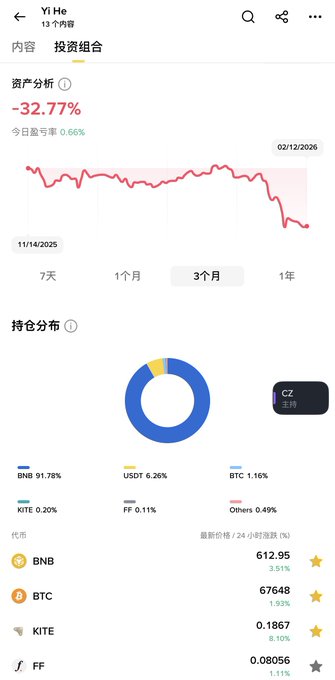
Many people like to discuss whether founders have faith, vision, and long-termism, but the capital market only looks at asset structure. For true founders, the alignment of wealth with the company is more convincing than any speech. Elon Musk's personal wealth is primarily derived from Tesla and SpaceX. His net worth fluctuations are almost entirely a function of Tesla's stock price; when the company rises, he rises; when the company falls, he bears the drawdown. He's betting his entire fortune on the company's future—this structure is a commitment. Even before SpaceX went public, he had already staked decades of value on it. Jensen Huang's wealth comes almost entirely from Nvidia stock (and also includes the world's most expensive Mercedes-Benz at $1.5 billion). He's held shares for decades without large-scale sell-offs, weathering even periods of undervaluation to become a chip tycoon. Mark Zuckerberg's wealth is highly concentrated in Meta stock. He controls direction through a dual-class share structure and has publicly stated that he will donate the majority of his shares to charity. He plans to donate a large proportion of his shares to long-term philanthropy after his death. His wealth trajectory is highly intertwined with the company's fate. In the crypto industry, this structure is even rarer. Whether it's CZ's net worth or the publicly disclosed holdings of the top female figure, the essence is highly concentrated on BNB and the Binance ecosystem. The rise and fall of BNB directly impacts personal asset size, and the success or failure of ecosystem development directly determines personal wealth curves. Even Forbes uses its BNB holdings as the core asset for its net worth calculations. This kind of binding essentially locks oneself into BNB. But there's another structure. The platform issues its own token, which circulates in the secondary market, yet the founder rarely publicly links their wealth to the token, and even less is seen of core team members holding this token. Users who follow the token don't seem to profit either. Instead, the founder is more enthusiastic about pushing for an IPO, because an IPO means larger-scale cashing out. A company IPO has nothing to do with retail investors; the founder won't airdrop shares to users, and users can't participate in pre-IPO price increases. When the founder's main wealth isn't highly tied to the platform token, the market naturally considers a question: whose interests are strongly tied to the long-term value of this coin? Where you stake your fortune, the market believes you're on that side. When the founder's wealth truly resonates with the platform's fate, long-termism becomes self-evident.
This article is machine translated
Show original

EnHeng嗯哼
@NB
一姐的持仓公开了🤣大家之前一直很好奇,她到底会拿什么资产
看完持仓分布,其实也不意外,一姐确实是言行一致,以 #bnb

From Twitter
Disclaimer: The content above is only the author's opinion which does not represent any position of Followin, and is not intended as, and shall not be understood or construed as, investment advice from Followin.
Like
Add to Favorites
Comments
Share
Relevant content