Musk has once again ignited the meme coin market, delivering a "large MC memecoin"—$ASTEROID—that has increased nearly 10,000 times in just 3 days to a wide range of players.
However, while this "large MC memecoin" (referring to a mainnet market, it also caused anxiety among SOL (Single Coin) traders...
"Space Dog" ASTEROID
ASTEROID was originally designed as a zero-g indicator for SpaceX's Polaris Dawn mission in September 2024. It was actually made into a plush toy and flew into space with the astronauts, alerting them to the arrival of weightlessness as it floated inside the capsule.
Although ASTEROID is not a real dog, it can be said to be the first Shiba Inu to go into space.
Liv Perrotto, the creator of ASTEROID, was herself a little girl. She hoped that ASTEROID would inspire all children to bravely pursue their dreams. "Look, even a little Shiba Inu went into space. When I grow up, I'm sure I can too." However, after battling bone cancer for five years, she sadly passed away on January 14th of this year.
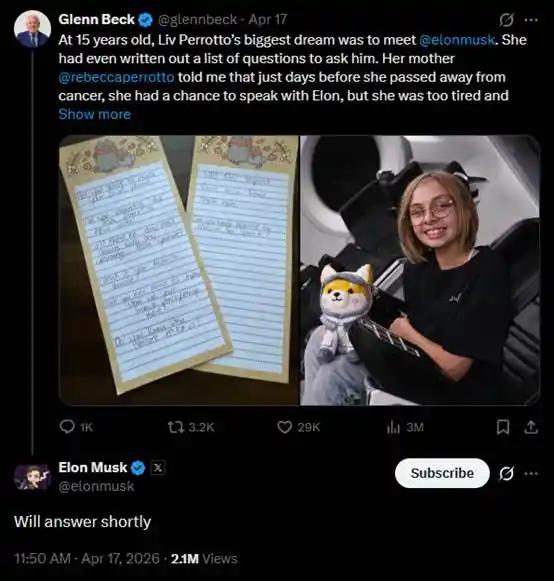
Liv's biggest dream was to meet Elon Musk. She even made a list of questions to ask him. After Liv's death, her mother, Rebecca Perrotto, released this handwritten list of questions:
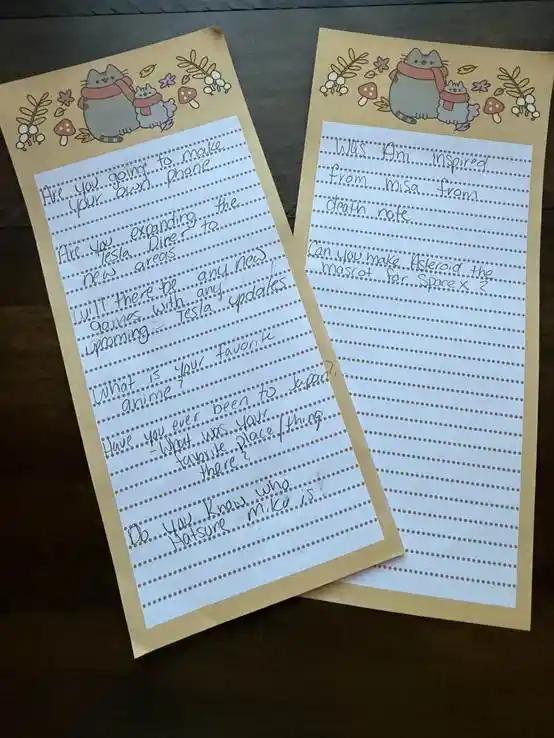
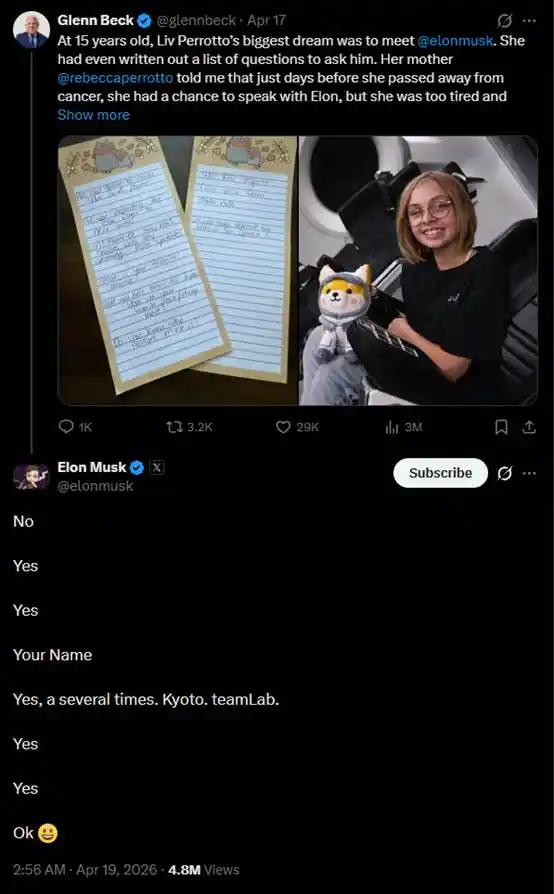
The last question on the list is, "Could you make ASTEROID SpaceX's mascot?"
On April 17, Musk replied to a tweet from @glennbeck mentioning the matter, "Answering later."
On April 19, Musk answered all the questions on the list, and to the question, "Can you make ASTEROID the mascot of SpaceX?", Musk replied, "OK".
A typical Musk narrative, and from a broad angle—SpaceX's new mascot. But this time, the wealth effect didn't occur on SOL, but rather on the ETH mainnet.
The ETH mainnet's $ASTEROID began operating in September 2024, but after March 2025, its Official Twitter became less active, updating only once every few months, and the official website linked in the Official Twitter bio is no longer accessible.
They once donated 0.5% of their coins to St. Jude Hospital, the same recipient as creator Liv Perrotto's donation of all proceeds from the sale of his Asteroid Shiba plush toys—to fund childhood cancer treatment. But that was back in 2024.
Rebecca Perrotto, the mother of creator Liv Perrotto, received 485.98 SOL in transaction fees for the token launched through the Bags platform. The total transaction fee revenue for this token has now reached 856.46 SOL.
After receiving the transaction fees, she did not publicly disclose this activity on X or other social media platforms, nor did she express any opinion on related meme coins on ETH or SOL. Her only statement regarding cryptocurrencies was actually unfriendly:
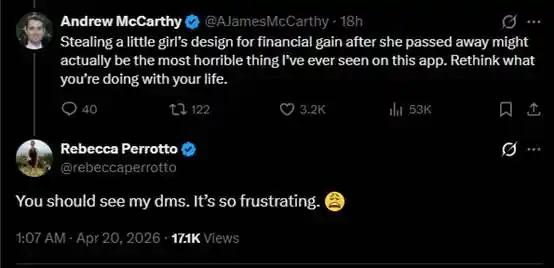
In the comments section of Aster's tweet announcing the listing of ETH ($ASTEROID), @AJamesMcCarthy stated that profiting from the creative designs of a deceased little girl is reprehensible. Rebecca Perrotto replied, "This is truly disheartening."
Therefore, both the old and new $ASTEROID coins have certain advantages from different perspectives, but it cannot be said that the old coin on the ETH mainnet ultimately stood out as a "victory for the community," because the CTO team had been inactive for more than half a year before encountering this major opportunity.
But there are still things that cause anxiety for the SOL trenches.
SOL was leeched.
Wojak is a classic meme character, familiar to meme enthusiasts. The stock on Solomon's List (SOL) began a slow recovery at the end of March, gradually rising from a market capitalization of $3 million to a peak of $12 million.
But all of this came to an abrupt end on April 17th, the day Musk announced he would respond to the Liv Perrotto issue. Since April 17th, the price of $WOJAK on SOL has fallen by more than 50%.

In contrast, ETH saw its price surge by approximately 44% on April 17th, and continued to rise in the following days, rapidly climbing from a market capitalization of $6 million to a peak of $45 million.

In just one day, the market capitalization lead of SOL, which was approximately 1 times that of ETH, was quickly reversed.
The flipping of $WOJAK on SOL is a dangerous signal for SOL players. Unlike native SOL memes like $neet or SOL memes with IP like $troll, neither ETH nor SOL's $WOJAK has IP. The competition between them is seen not only as a competition of community vitality but also as a reflection of fund preferences. While native, high-quality SOL memes remain unaffected, and even $troll on SOL rose (though not as dramatically as $troll on ETH), such coins are few and far between.
Will pump.fun face challenges?
Many English-speaking users believe that Pump.fun's low-cost token issuance no longer signifies a "fair launch," but has become a race to the top, where everyone tries to acquire 5% or more of the tokens faster and cheaper. They miss the days when they bought 0.x% of the tokens, sharing a common dream of reaching a market capitalization of hundreds of millions or even billions of dollars.
While it's unclear whether this sentiment will actually lead to changes in the SOL ecosystem, some launchers have already attempted to leverage it to challenge pump.fun.
Printr, a launchpad powered by Bybit, has introduced "Proof of Belief," a mode that developers can enable when issuing tokens to distribute creator revenue to token stakers. Alternatively, creator revenue can be automatically used for buybacks and burns, or automatically added to limited partners (LPs).
The popular new token issuance model experiment comes from @xbt2027, who calls it "D27/D17". Its main token $2027, issued on the ETH mainnet, has increased by about 15 times since its issuance.
Compared to the Boding Curve, this mode is much slower to play, and it consists of 5 phases:
Phase 1: 10% of the total token supply will be used for initial fundraising, similar to depositing money into a wallet and waiting to receive tokens, but with a 100% refund option.
Phases 2, 3, and 4: Up to 5% of the total supply of tokens will be allocated, with token valuations increasing by 1.21x, 1.44x, and 1.69x respectively compared to Phase 1. Refunds are still available, but not 100%; the refund percentage for each phase depends on the fundraising results of the previous phase.
- Phase 5: If the fundraising amount does not reach the upper limit, the unsold tokens allocated in Phases 2, 3, and 4 will be carried over to this phase. This phase also has a fixed sales quota allocation of 5% of the total supply, and this phase is non-refundable.
Through the sale, 20% of the total tokens were sold in the above 5 stages, another 10% were locked up with LPs along with 90% of the sale proceeds, the remaining 10% of the sale proceeds were used to repurchase $2027, and all remaining issued tokens were burned.
It's called an "experiment" because the model hasn't yet been formalized through smart contracts, establishing a pattern and automated operation. Currently, two tokens have completed fundraising through this experiment: $2027 issued on the ETH mainnet and $XBT, which will be launched on SOL. $XBT raised a total of 8146.349 SOL and will be listed on TGE at 00:00 on April 21st.
This model is clearly designed to slow down the pace, reward believers (with the highest entry costs and refund flexibility in Phase 1), and address current issues such as early-stage sniping and poor liquidity in the meme coin market.
While it's uncertain whether these new trials or launch pads can reverse the overly PvP-heavy state of the SOL ecosystem, the actions of these project teams suggest that the resentment towards PvP on SOL has grown so strong that project teams believe they can leverage this sentiment to attract users and achieve a breakthrough. Perhaps the SOL ecosystem is indeed about to undergo some changes. Perhaps pump.fun is also feeling anxious.