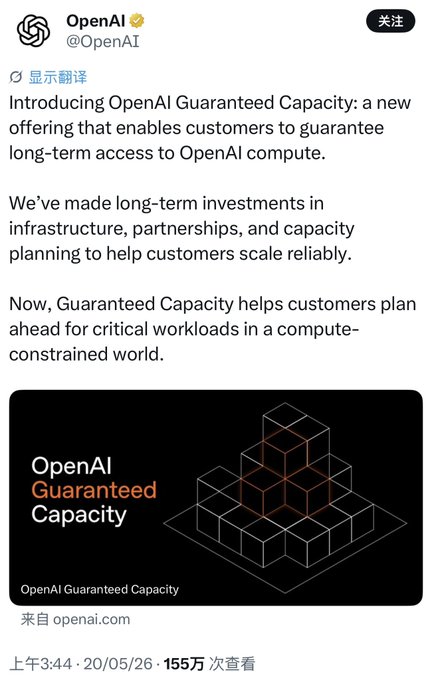
Long-Term Agreements (LTAs) are changing the AI ecosystem. OpenAI's "Guaranteed Capacity" or similar enterprise-level capacity guarantee plans for B-end (enterprise customers) are essentially long-term LTAs. It's undeniable that LTAs are transforming the AI ecosystem. Previously, LTAs began in the upstream AI computing power supply chain: 1) Storage vendors required downstream chip customers to sign long-term supply agreements to lock in demand before expanding production (this is the core logic behind many investment banks' belief that it will change the valuation methods of storage vendors); 2) Nvidia signed long-term agreements with Lite and Cohr to prioritize the supply of key components such as lasers and optical interconnects in order to promote CPO (Consumer Product Ownership). 3) Large-scale model vendors offered numerous long-term computing power agreements to cloud providers to secure computing power. Now, OpenAI is extending this "long-term contract capacity lock-in" model from the upstream supply chain to the downstream enterprise end. This priority guarantee and discount lock-in mechanism, offered to enterprise customers against the backdrop of scarce AI computing power, offers significant benefits: 1) Addressing computing power bottlenecks and providing enterprises with certainty: By signing 1-3 year long-term agreements, enterprises can lock in discounted token prices and priority access rights (including cutting-edge models such as the GPT series, o series, and Agent). For enterprise customers, this means controllable budgets, lower costs, and protection from sudden rate throttling or price increases, making it suitable for large-scale deployment of AI Agents and productivity tools. 2) For large model vendors: Previously, OpenAI's enterprise revenue primarily relied on ChatGPT Enterprise + API pay-as-you-go billing. The LTA allows OpenAI to obtain predictable, high-return revenue in the long term (similar to LTAs for chip manufacturers), helping them plan for massive CapEx (capital expenditure) while securing large clients. Of course, the core significance is accelerating B2B penetration and seizing the enterprise AI market. OpenAI is heavily shifting towards the B2B market (Frontier platform, Deployment Company, Codex, etc.), and the proportion of enterprise revenue has significantly increased. LTA serves as a "moat" tool, binding itself to leading companies and helping OpenAI compete against rivals like Anthropic and Google. Given its effectiveness, it's believed that companies like Anthropic and Google will quickly follow suit. LTA can be seen as a crucial step in commoditizing scarce computing power, providing reassurance to companies and securing long-term cash flow and market dominance for large-scale model vendors. This also represents a significant step towards further "infrastructure-izing" large-scale models.
This article is machine translated
Show original

qinbafrank
@qinbafrank
05-05
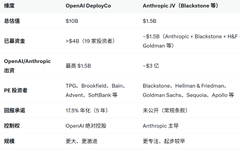
Why are large model vendors all forming joint ventures with investment institutions? This means that competition for large models on the B-end has entered a ground trench warfare mode. In the past couple of days, the biggest moves by large model vendors have undoubtedly been x.com/qinbafrank/sta…


From Twitter
Disclaimer: The content above is only the author's opinion which does not represent any position of Followin, and is not intended as, and shall not be understood or construed as, investment advice from Followin.
Like
Add to Favorites
Comments
Share
Relevant content