This article is machine translated
Show original
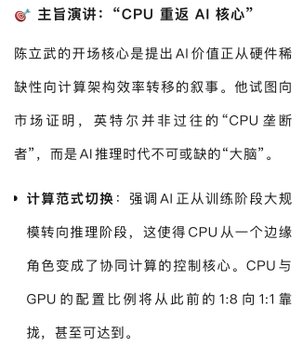
Today, Chen Liwu's speech boosted the CPU sector again, with ARM showing the largest increase. In fact, in early to mid-April, CPUs became a key component of proxy AI. A highlight of Chen Liwu's speech today was his first mention of a CPU-to-GPU ratio approaching 1:1, moving away from the previous 1:8. In Intel's earnings call in late April, he also mentioned a move towards 1:4, representing a significant increase in the ratio and naturally stronger market expectations.
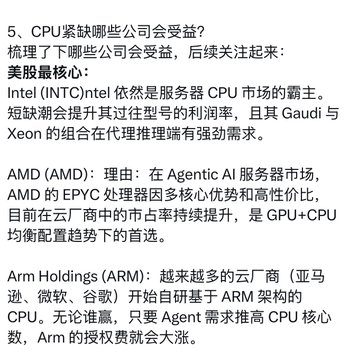
The tweet from mid-April also explicitly mentioned that the CPU shortage would benefit US stocks like Intel, AMD, and ARM. A month later, all three stocks have seen substantial gains: Intel has doubled, while AMD and ARM have risen by approximately 60-70%.
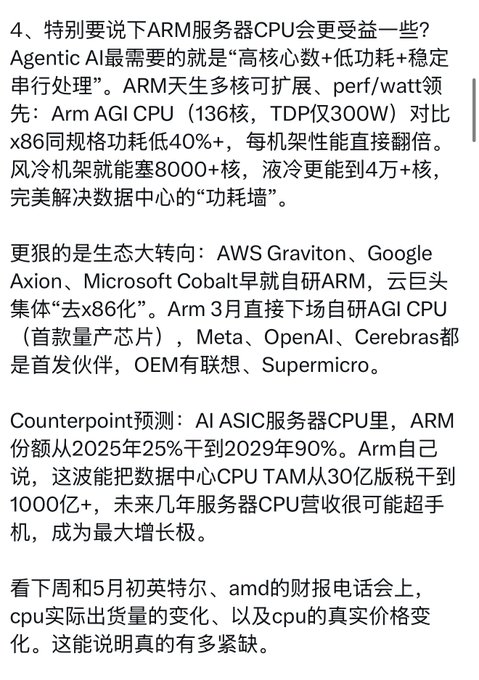
However, it's worth discussing that ARM had the largest increase among the three stocks today: firstly, ARM has the lowest market capitalization; secondly, the market may have recognized that in the era of proxy AI, the ARM architecture actually has advantages over the x86 architecture, as discussed in the mid-April tweet. Therefore, Nvidia's Vera CPU, and the self-developed CPUs of Amazon, Google, and Microsoft all use the ARM architecture.

qinbafrank
@qinbafrank
04-17
In the migration from generative AI to agentic AI, a new bottleneck has emerged—this time, it's the CPU. Previous market discussions on compute shortages focused on GPUs, HBM, optical modules, power supply, and other links, with relatively little attention paid to CPUs. In fact, x.com/qinbafrank/sta…
Its biggest advantage lies in its cost-effectiveness in terms of energy consumption and computing power.
Yes

From Twitter
Disclaimer: The content above is only the author's opinion which does not represent any position of Followin, and is not intended as, and shall not be understood or construed as, investment advice from Followin.
Like
Add to Favorites
Comments
Share
Relevant content