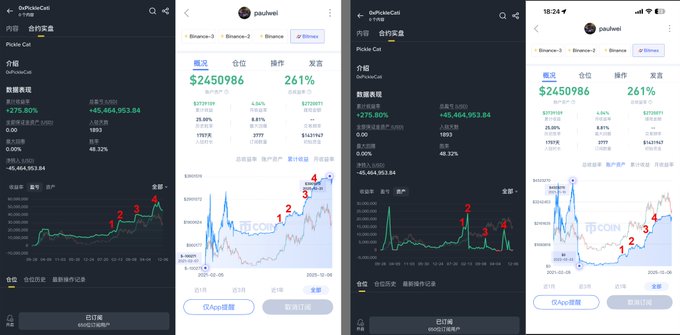
It's unbelievable that someone in the world has such a similar profit/loss curve to me, yet our trading styles are completely opposite! Have I finally found a long-lost bro?
@coolish Compare our live trading charts side-by-side; you can see the profitable phases are almost identical.
But here's the question: given that high-frequency trading is generally unprofitable for most people, how come:
He trades 10+ times a week
I barely make a few trades a quarter
Then why are our curves still almost synchronized?
I'll use my childhood favorite game, League of Legends, as an analogy:
I'm like someone who lurks in the bushes, waits for the right moment, unleashes a devastating attack, and then retreats from the battlefield, waiting for the next opportunity.
He's more like someone who likes to be in the center of the battlefield, probing back and forth with the enemy, looking for their mistakes, and then initiating a team fight with his ultimate.
⚠️Here's the key point:
Regardless of our fighting styles, we both win by winning a crucial team fight, so of course our curves look similar.
The problem for most retail investors lies here:
> Many people don't understand "high-frequency" trading as last-hitting minions.
> It's about constantly engaging in meaningless team fights.
> They force team fights when it's not their time.
> However, there are only one or two truly crucial team fights that can secure victory.
> If you treat every move like a high-risk, high-reward bet, you'll inevitably get wiped out by the market.
His kind of "high-frequency" trading
is actually: last-hitting minions, farming jungle camps, trial positions, and micro-management. The truly crucial team fights where you unleash your ultimate skill occur are at a low frequency, similar to mine.
⚠️ But ordinary people simply can't control this balance. Traders like Paul (a genius) are one in a million. Some retail investors don't learn, don't practice, and just watch Paul's high-frequency trading and think it's cool. Many high-frequency day traders aren't lacking in talent, but rather they haven't found the right timing and waste opportunities.
So you either need to thoroughly understand Paul's methods, or reduce your trading frequency and wait for the right opportunity.
Thanks to Paul for providing such a valuable supplementary perspective. I truly hope that more truly skilled traders will share their insights in the future.
There are already few true players in the market, and even fewer who can voice their opinions. Cherish them.
twitter.com/0xPickleCati/statu...