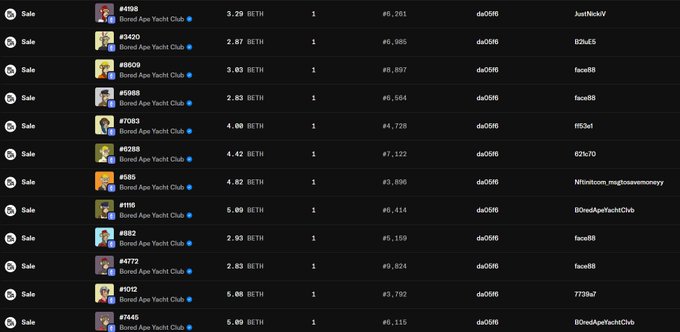
#Blur issued coins, detonating the biggest hot spot on the NFT track in February?#
At 1 am on February 15th (UTC+8), the NFT market Blur officially issued the native token BLUR. According to data from Dune Analytics, since its internal test launch in July 2022, Blur has achieved a total transaction volume of 270 million US dollars, ranking third among NFT aggregation platforms.

Latest
Featured
avatar
Nick Szabo
02-01
This is zeroing in on the actual origin story of Jeffrey Epstein — one that mainstream summaries intentionally blur. Most reporting portrays Epstein as some inexplicable “mystery billionaire” who “came out of nowhere,” yet his earliest documented professional context — Bear Stearns in the late 1970s — connects directly with the covert financial infrastructure of the Cold War and Iran-Contra. Gary Webb and I documented quite a bit that Gary never published. This weekend I will share a report on the pattern that continued: from BCCI to Mega Group. Epstein’s personal Rolodex developed through these shadowed networks: Adnan Khashoggi and the Saudis (arms and covert logistics), Robert Maxwell and the Israelis (information operations), Les Wexner and the Mega Group (U.S.–Israeli influence network of billionaires). In essence, Epstein’s later “financier” cover was merely a continuation of the same service Bear Stearns trained him for — hiding and moving intelligence-linked money streams under the guise of private wealth management. The sexual blackmail component later added another layer: not simply recreational abuse, but leverage operations, typical of intelligence culture going back to the Profumo Affair in the UK and the Franklin coverup in the U.S.
Mike Benz
@MikeBenzCyber
12-21
This is it. The key to Epstein: Bear Stearns put him on BCCI trades in 1979, as it made millions helping the CIA, Brits, Saudis & Israelis disguise covert cash by clearing $13 billion with BCCI, a CIA money laundering bank. Epstein simply developed that clientele & career niche.
LGNS
5.26%
avatar
Yuyue
01-28
Thread
It's been a long time since I've had the motivation to finish reading something this long. Perhaps it's because, as a Gen Z, I resonate deeply with @0xPickleCati's ideas. I read the whole thing and was deeply moved. Even though I've recently reduced many positions, I still stumbled on Intospace. Just now, I received more bad news: the Moonbird NFT requires two years to unlock the airdrop. In my opinion, this is practically worthless. I bought some Moonbirds before, and now I probably won't even recover a fraction of my cost. These repeated setbacks have made me start reflecting on where things went wrong during this period of liquidity depletion. Is it just a liquidity problem? I don't think so. According to @0xPickleCati's consensus upgrade standards, even in past bear markets with poor liquidity, there were always new things like Inscription and FriendTech appearing, and even pre-sales, like Soon, which is often criticized for its ref trading, allowed many people to earn over $100,000. Thinking back to the reasons for participating: the team was verified, there was a good example in the SVM sector that had issued a token, and the CEX had some support and connection... Does this sound familiar? In my opinion, this should be considered a typical case of a simple To CEX model. Based on my own experience of about 3 years in the industry, the projects I've encountered can be roughly divided into the following categories: - To Vitalik, because a large number of Vitalik's followers believe that Ethereum is the future, and it is mainly composed of a series of infrastructure projects, ZK projects, etc., as long as Vitalik has people willing to pay for it. - To VCs, as long as a project can get endorsement from a high-quality VC, it can gain widespread recognition in the market. For example, Blur and FriendTech were actually supported by @paradigm and gained momentum. With a few signal VCs, there are people willing to pay. - To CEX, everyone discovered that anything associated with CEX was guaranteed to make money; the CEX brand alone would attract buyers. This era is halfway over, but not entirely. Large VC projects have lost their momentum, leaving only memes to continue. Therefore, the simple model of "To CEX" is no longer viable; listing on an exchange no longer fully guarantees a price floor, and people are no longer entirely willing to pay for it. What's next? To MM? River is one of the best recent examples, but the difficulty of betting on these projects will definitely be higher, and the vast majority of participants will lose money. The lifespan of retail traders will be shortened. Thus, we can see that in recent years, regardless of what projects are "To" (the startup), none have truly "To" the community. At this stage, let's not even talk about product issues; it's all about hype. For example, the other day, rocket and aerospace stocks doubled at the opening, and everyone planned to make a profit and leave after riding the hype. In reality, they knew when they bought that it had a good concept to ride, but the sustainability was undoubtedly very poor. Because these cryptocurrencies, aside from their speculative value, currently lack any "consensus," and even their narratives are weak. Essentially, this aligns with her point that "no new elements can create synergy among new participants." Since $TRUMP, what narrative can surpass it and build consensus? I don't have the answer to this question, but I have two viewpoints that might explain the despair and confusion in the crypto that "this element will not be generated again": 1. Capital outflow. BTC is significantly lagging behind precious metals and other commodities, as well as hot sectors in the US stock market. Capital is voting with its feet; ETFs are experiencing continuous outflows, not to mention other crypto assets. 2. The talent drain. The current inability of the crypto to attract good projects and developers stems from several factors: social status, opportunity cost, and traditional reputation. High-quality developers can naturally achieve both fame and fortune safely on Web2, so why would they want to issue tokens for their excellent products on cryptocurrencies? Especially since many capable developers don't want to "make quick money." This is a problem; talent and capital are being drained, and the lack of appeal in the crypto sector is an objective fact. Therefore, there's a point discussed at the OKEx New Year's Eve dinner: sector rotation. Perhaps we can wait for the inflow of funds during this rotation, which would be a simple model for liquidity recovery, a result of a new consensus being established. However, no one can predict the future of this. (Of course, the prediction market might be one answer, which is why I'm optimistic about this sector, even though the most lucrative period for prediction markets might not currently belong to the crypto.) My consistent approach has been to follow the trend, not predict. When hype and speculation in the crypto attract buyers, it's a bubble, proof of liquidity. But crypto still holds much more promise for the future, such as the widespread adoption of AI agents. The technological singularity hasn't arrived yet, but once it does, I believe the existing production relations will be transformed. That might be the future of "onboard billions onchain." Until then, the most important thing is to wait and survive at the table. twitter.com/yuyue_chris/status...
TRUMP
2.16%
loading indicator
Loading..