Which tracks have the highest gas consumption?
Written by Terry

Since the London upgrade on August 5, 2021 (block height 12965000), combined with the fee destruction mechanism, from an economic model level, all types of on-chain activities in Ethereum (token transfers, NFT minting, etc.) will boost ETH’s growth. combustion.
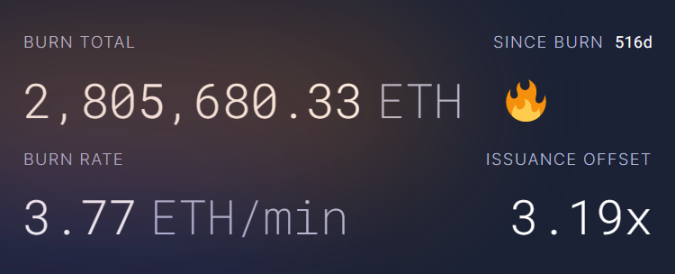
Each of the "basic handling fees" will be directly destroyed, reducing the supply of ETH on the entire network, which is equivalent to bringing a "deflation dividend" to all currency holders . According to ultrasound.money data:
As of January 4, 2023, the total amount of Ethereum destroyed in 516 days has exceeded 2.8 million, with a total value of nearly 3.4 billion US dollars. The annual destruction volume is about 2 million, and an average of 3.77 ETH is destroyed every minute.
01 Gas consumption total ranking
The Ethereum network consumes 2 million ETH through Gas fees in one year. Which applications (smart contracts) are the main sources of Gas consumption? Let’s take a brief look at the data of the top ten in the overall rankings.
Unsurprisingly, the application that destroys the most Ethereum is the gas consumption of Ethereum transfers - since the London upgrade, Ethereum transfers have destroyed more than 253,000 ETH, accounting for about 9.03% of the total amount destroyed.
Followed closely by OpenSea (buying and selling NFT collectibles), which has destroyed more than 230,000 Ethereums since the London upgrade, accounting for about 8.21% of the total amount destroyed; at the same time, OpenSea (trading contracts) is also on the list Ranked sixth, Gas consumption exceeds 70,000 ETH.
Therefore, if the two are combined, OpenSea's total gas fee consumes more than 300,000 ETH, accounting for more than 10%, surpassing Ethereum and ranking first.

Uniswap V2 and Uniswap V3 ranked third and fifth respectively , accounting for 5.15% (144,300 pieces) and 3.99% (111,900 pieces) respectively; and the gas consumption of USDT, which ranked fourth , also reached a cumulative total of 123,300 pieces. , accounting for 4.4%.
Followed closely by Yuga Labs metaverse project Otherside plot , ranking seventh with a consumption of 56,000 ETH; MetaMask's built-in Swap also consumed 54,000 ETH, ranking eighth; USDC ranked 51,000 ETH Ninth ; Another routing contract of Uniswap V3 ranked tenth with 47,800 pieces.
From the overall data, in addition to basic Ethereum transfers, the top projects in the overall ranking are well-known head projects such as OpenSea, Uniswap, and USDT. The total gas consumption of the top 10 in the ranking is basically 50,000 ETH. Above, the Gas consumption of the top 27 applications all exceeds 10,000 ETH.
02 Which tracks have the highest gas consumption?
Furthermore, we can analyze and observe the specific distribution track and head projects of ETH's Gas consumption, which also hides the most active seed players in the bear market.
(1) DeFi track: Uniswap and other DEXs are at the core
DeFi is the central pillar of the Ethereum ecosystem, and DEX is used to promote the asset exchange and liquidity flow of the entire DeFi and is the core of DeFi.
Therefore, Uniswap, as the "DEX leader", almost contributes to the main gas consumption of DeFi. If all the data of V2 and V3 (including different transaction routing contracts) are combined, Uniswap's total gas consumption exceeds 300,000 ETH, accounting for 10.86% of the total ETH consumption of Ethereum.
Besides Uniswap, the next DeFi project is the DEX aggregator 1inch v4, which consumes more than 25,000 ETH in total gas; followed by SushiSwap with 23,000 ETH and 1inch v3 with approximately 16,000 ETH.
In addition to DEX, there are almost no other types of projects on the DeFi track.
(2) NFT track: Otherdeed stands out
In the NFT track, OpenSea, as the leader in the trading market, has a relatively stable position, so we analyze it based on specific NFT projects.
According to Oklink statistics, we can intuitively find from the figure below that the daily Gas consumption of the Ethereum network is closely related to the market trend - it will be at a high level almost simultaneously in 2021, but since 2022, especially after the collapse of Terra in May 2022, Secondary market prices and sentiment are becoming increasingly depressed, and gas consumption has also dropped by a notch.
But May 1 was an exception, with a single-day consumption of 80,000 ETH, setting a record high and far surpassing other highs.

However, as can be seen from the above figure, the number of Ethereum network transactions on the same day did not surge significantly. Therefore, it can be seen that Ethereum transfers were not the main force in ETH consumption that day. So what happened on May 1st?
At 9:00 on May 1, the Yuga Labs metaverse project Otherside plot NFT Otherdeed started casting, with a total amount of 55,000.
This caused the gas fee of Ethereum to rise to nearly 10,000 Gwei at one time, contributing an absolute proportion of Gas consumption. In the eight months so far, Otherdeed ranks seventh with a consumption of 56,000 ETH. If based on the average monthly consumption, Otherdeed was also able to surpass Uniswap V3 and join the top five.
Nansen statistics also show that after Yuga Labs launched Otherdeed for Otherside, the weekly transaction volume on Ethereum reached US$1.6 billion in early May, far exceeding the other months of last year.
In addition, the total Gas consumption of the closely followed ENS series is only 24,000 ETH, making Otherdeed unique in the entire NFT track.
(3) Stablecoin track: USDT and USDC are firmly at the forefront
While NFTs, DeFi, and DAOs have taken center stage in cryptocurrencies over the past few years, stablecoins have been quietly growing in the background.
Among them, USDT ranks first with a total gas consumption of 123,300 ETH, followed by USDC with a total gas consumption of 51,600 ETH. Other stablecoins are hard to find.
At the same time, ultrasound.money data also shows that based on TVS (total guaranteed value used by oracles), USDC surpasses USDT ($32.29 billion) with $41.12 billion.

Overall, USDC leads by a large margin in many on-chain data dimensions. It is the most liquid on DEX, the most deposited in the money market, the third most liquid on cross-chain bridges, and the most widely used stablecoin supported by DAO treasury and assets. , it is clear that although USDC is only the second largest stablecoin in the market by market capitalization, USDC is by far the most used on-chain stablecoin in the crypto world.
In addition, applications on other tracks such as MEV Bot and Polygon Bridge also consume more than 10,000 ETH.
03 Summary
Generally speaking, in 2021, Ethereum completed the London hard fork upgrade and opened the era of Gas destruction; in 2022, it successfully entered the PoS era through merger. From November 9 to December 1, 2022, the supply of ETH entered the deflationary range for the first time since the merger, and the changes were difficult and sudden.
In the new year of 2023, the foreseeable Shanghai upgrade is expected to be carried out in March. At that time, it is planned to open the withdrawal of ETH pledged by the beacon chain. Let us wait and see what impact it will have on the Ethereum network and various tracks.