
Recommender systems are expected to proliferate in the next few years and take share from traditional search.
Author: Alpha Rabbit
Cover: Photo by DeepMind on Unsplash
event
This article is about 2100 words
The "search" track represents a trillion-dollar opportunity across the consumer, business, and developer ecosystems. As search systems become more personal, we predict that the line between search and recommendation will become Vague. We expect recommender systems to proliferate in the next few years and take share from traditional search.
BVP recently published an article , which mentioned:
The technological breakthrough of artificial intelligence is reshaping the new mode of information synthesis and retrieval. Since last year, the popularity of products like ChatGPT, Stable Diffusion, and Dreamfusion, as well as the upcoming GPT-4, etc., the potential of large models has inspired many new startups. The searches mentioned here are not just public Internet searches like Google.
The search here refers to the ability to query information, and finally synthesize and draw conclusions.
The definition of "search" here includes enterprise (B-side) file search, to C-side conversational search products and so on.
The "search" track represents a trillion-dollar opportunity that spans the consumer, enterprise, and developer ecosystems: With an overview map of AI-powered search, we explore what is catalyzing this evolution.
redefine search
Advances in machine learning and software infrastructure have unlocked new types of data, and search has the ability to understand context, so where are these advances coming from?
1. Advanced multimodal models emerge. It is very difficult to search unstructured data such as images and videos. However, recent advances and technological breakthroughs, like text-image models such as OpenAI CLIP and LAION, have improved the fidelity of models by embedding unstructured data into compact representations. These representations are often represented as vectors, enabling more advanced multimodal models for images, videos, and various other rich data types. For example, Coactive.ai provides a SQL query interface for image data, which can help teams quickly access, organize and utilize their visual data.
2. Advances in contextual awareness and basic reasoning: While past search systems provided keyword searches, modern models provide semantic search, or the ability to search meaningfully. Modern search systems are also context-aware and refer to user intent and historical behavior. And now, thanks to large language models, these systems can perform basic inference tasks. In this way, a more intuitive and conversational search is brought, which can not only understand the search history, but also conduct comprehensive research and judgment.
A typical example is OpenAI's ChatGPT - which provides better search tools . ChatGPT presents information in the form of a seemingly stateful, human-like response that users can iteratively refine and tweak their search experience.
For example, if a user asks, "What should I wear today?" the AI tool might start by asking probing questions like, "What do you want people to think about your style?" and then synthesize an answer.
3. Ability to build on existing results. Many large language models plug into existing software stacks (such as Perplexity, Adept, OpenAI's Codex and Google's Mind's Eye's next-generation search products, etc.) through integration with APIs and dynamic interaction with user interfaces. Similarly, companies like Seek.ai and Hearth.ai can also embed their models in databases and CRMs. As language models are more connected to existing products, search systems can cover more fields and be more efficient. Good for notification posting.
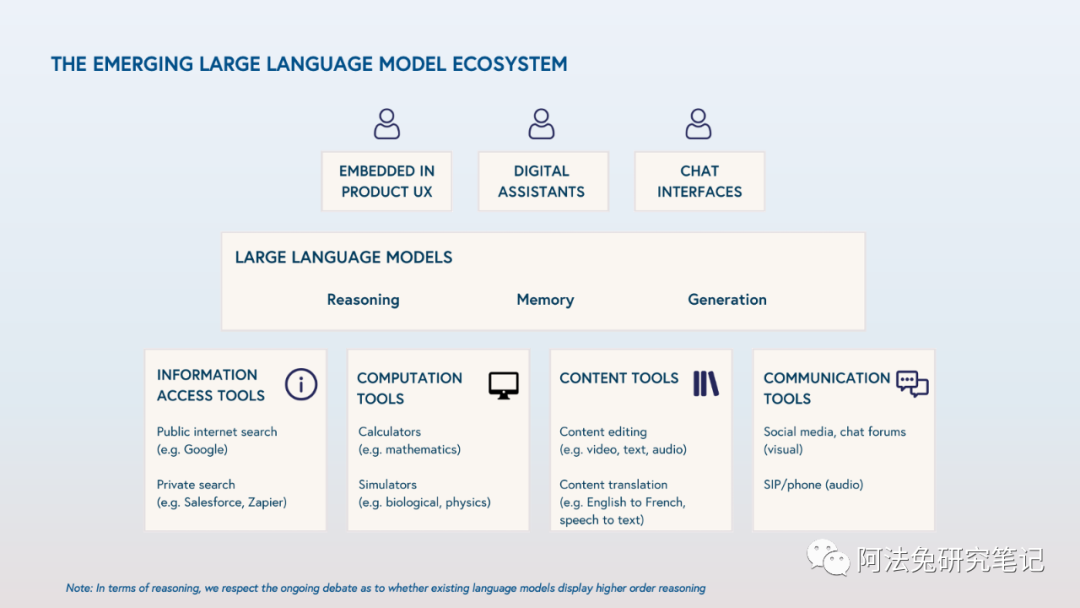
Emerging large language model ecosystem
4. Infrastructure scale: The company discovered the embedding vector ( note: using a vector to represent a word/a sentence/a picture is called embedding, because the essence is to preserve high-dimensional image/language information on the premise of retaining a certain local metric Mapping down to a lower latitude space ), you can continue to build and scale workloads on vector databases such as Zilliz (Milvus), Pinecone, Vespa, and Weaviate, as well as open source libraries such as Jina, Qdrant, and FAISS. In addition, researchers are also studying how factors such as model size and data volume affect the model performance of large neural networks. The field of distributed deep learning has begun to develop, and scheduling optimization and (data) parallel technologies can further expand artificial intelligence models and data volumes. Schedule optimization
5. The boundary between search and recommendation will gradually blur. As search systems become more personal, we predict that the lines between search and recommendations will blur. For example, TikTok has developed rapidly in recent years. ByteDance's personalized and continuously improved recommendation mode experience has successfully seized market share from traditional video search products such as Youtube. surge and take share from traditional search.
Artificial intelligence is reshaping search. We're seeing persistent innovation in both consumer and enterprise search as well as the infrastructure layer.
AI Search Market Overview
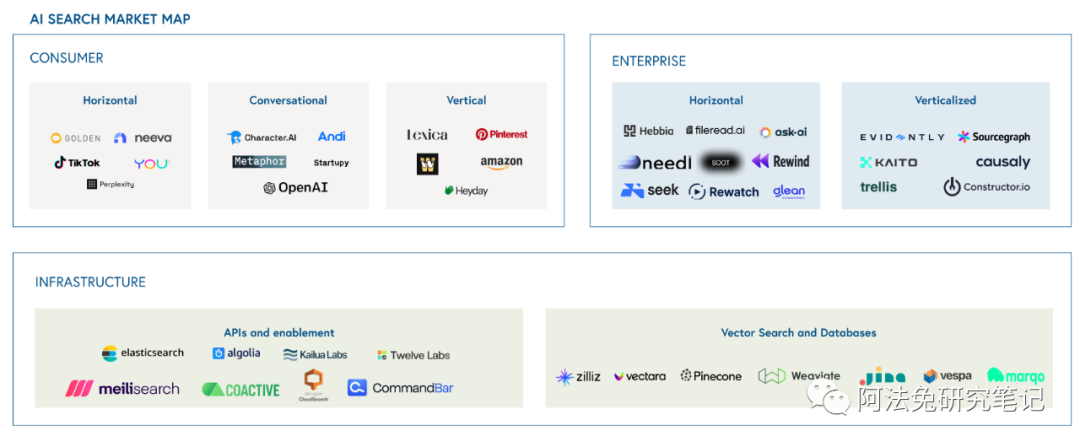
If we look at the artificial intelligence search market, a series of companies have emerged on the artificial intelligence search track, such as To C's (Tik Tok is also counted among them, and the world's first private and wireless platform like Neeva's). Advertisement search engine), To B, and those who focus on infrastructure, etc.
Smart Search: An Era Just Beginning
The amount of digital content will explode as AI reduces the quality and production costs of high-quality created content. We predict that within the next decade, at least 50% of online content will be generated by or enhanced by AI. With the advent of the era of information explosion, better intelligent search will be needed to organize and summarize this information.
As user data becomes more and more important, and even becomes a key asset of enterprises, enterprises can use search experience to better analyze data for business decision-making, while in the consumer environment, people will be more accurate, more personalized, Benefit from more granular results that will impact the way people connect, shop or learn.
references:
1. https://www.bvp.com/atlas/entering-the-era-of-intelligent-search?utm_source=email&utm_medium=organic&utm_campaign=entering-the-era-of-intelligent-search
Disclaimer: As a blockchain information platform, the articles published on this site only represent the personal opinions of the authors and guests, and have nothing to do with Web3Caff's position. The information in the article is for reference only, and does not constitute any investment advice or offer, and please abide by the relevant laws and regulations of the country or region where you are located.