avatar
Steven | Crypto Research
12,600 Twitter followers
Follow
Long-term specialist investor - Crypto Researcher, Founder SR Research Group: https://t.co/RratB6ai75
Posts
avatar
Steven | Crypto Research
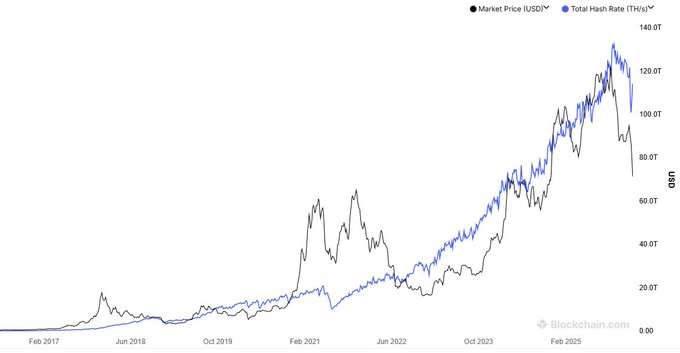
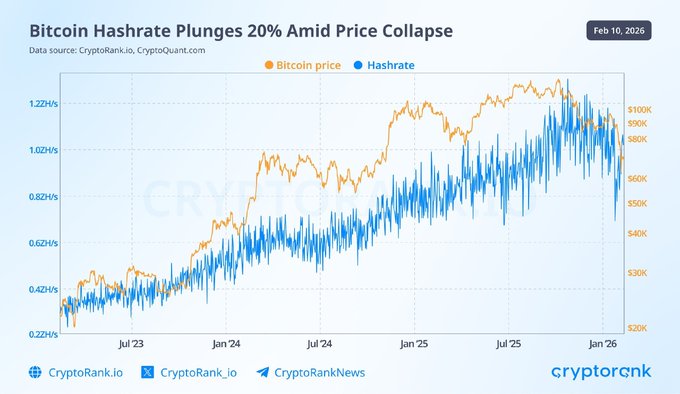
Bitcoin mining hashrate drops 20% - Is this related to the price of $ BTC? Hashrate, which represents the mining difficulty of Bitcoin, has just experienced its biggest drop since 2021, causing weaker miners to leave. So what caused this and does it correlate with the price? 1. Analyze the causes of the hashrate decline. - When the price of BTC drops sharply, the revenue of Miners (calculated in USD) is no longer enough to cover electricity and operating costs, forcing small-scale Miners or those using older machines to disconnect. - By early 2026, winter storms in the US (where many large mining farms are located) caused rolling power outages or soaring electricity prices, making it uneconomical to maintain hashrate. - A new trend in 2025-2026 is for Bitcoin mining companies to shift their infrastructure to powering AI (High-Performance Computing - HPC) data centers due to the stable and higher profitability compared to mining BTC in a bear market. 2. Correlation Between Hashrate and BTC Price - In the short term, prices usually fall first, then hashrate decreases (because Miners need time to assess profit/loss before shutting down their machines). - When the hash rate drops sharply (~20%) and a difficulty adjustment occurs, this is often a signal of " Miners capitulation". History shows that large hash rate drops (like in 2021) often mark the end of a price decline, establishing a new long-term price range. 3. Consequences for the price of BTC - Once the less skilled Miners have left the game, the selling pressure from this group to cover costs will dry up. - The market needs time to absorb the sell-off in BTC . The price may form a consolidation zone around the current support level. - After the difficulty decreases, the increased mining efficiency will attract newer, more efficient machines back to the network. Hashrate will gradually recover and set a new all-time high (ATH). twitter.com/Steven_Research/st...

BTC
1.48%
avatar
Steven | Crypto Research
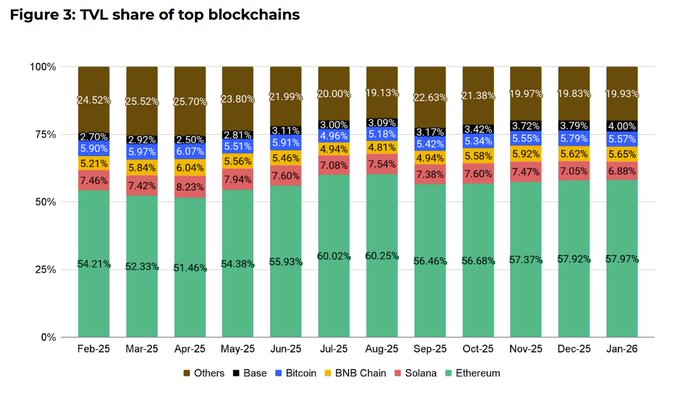
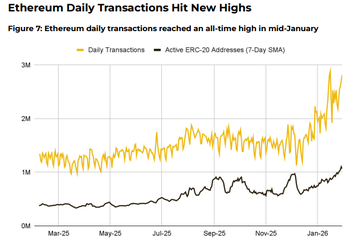
ETHEREUM'S IRREVERSIBLE POSITION - Despite intense competition and expansion efforts from numerous large ecosystems, Ethereum's DeFi market share remains dominant at 57.97% of the total value locked (TVL) across the industry. Although this figure has fluctuated slightly from 54.21% in February 2025, Ethereum continues to demonstrate its resilience and superior Capital absorption capacity compared to its competitors. - The Fusaka upgrade, implemented at the end of 2025, addressed the critical data availability issue through PeerDAS, helping the number of daily transactions peak at nearly 3 million by mid-January 2026. The number of daily active addresses maintained steady growth and officially surpassed 1 million. - Over 65% of real-world Tokenize assets (RWA) choose Ethereum as their storage and trading platform. RWAs alone have a TVL of $19.5 billion. - The Capital of stablecoins on the network remains stable at $160 billion. The volume of stablecoins is expected to reach $1 trillion by the end of 2025. - Although the Ethereum Mainnet is increasingly becoming a safe haven for large Capital flows (whales) and institutional assets, small-scale and high-frequency transactions are shifting to Layer 2 or competitors like Solana (currently holding around 6.88% of TVL market share), creating polarization among users as they gravitate towards specific chains. Ethereum remains the largest funnel capturing value in the entire DeFi industry, but its market share is also highly Shard . twitter.com/Steven_Research/st...
ETH
0.56%
avatar
Steven | Crypto Research
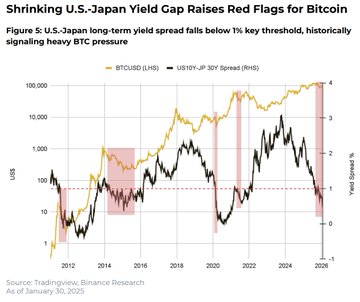
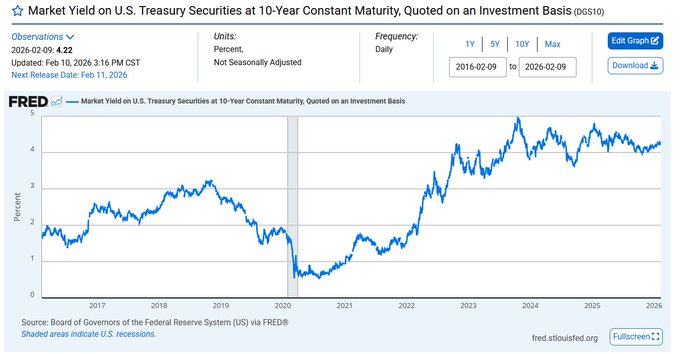
Yield Shifts and Pressure on the USD - The Relationship with Bitcoin - The yield on 10-year US Treasury bonds is approaching 4.19%. Meanwhile, Japanese Treasury bond yields (JGBs) are beginning to cool down after reaching historical highs. This tug-of-war reflects the conflict between extreme policy measures and the need for foreign Capital . - The DXY index no longer holds its dominant position. After falling 9.2% in 2025, it continued to lose another 3.1% in the first month of 2026. Conversely, currencies like the Euro and Japanese Yen are recording strong recovery momentum thanks to the Fed's caution and uncertainties from US trade policy (tariffs). - As the yield spread narrows, the profit from borrowing yen to invest in USD assets disappears. This forces investors to unwind, withdrawing liquidation from risky global assets. - Historical data from 2011, 2014, and 2021 shows that whenever this yield spread narrows and breaks through the 1.0% threshold, the price of Bitcoin $BTC usually faces significant downward pressure. Currently, short positions in the Yen remain significantly lower than their 2024 peak. This implies that there isn't much "dry wood" left to create a liquidation crisis (Yen Panic) like the one in the summer of 2024. => Although BTC is facing resistance from narrowing spreads, the current market structure is more mature than in previous cycles. Downward pressure is real, but its intensity is likely to be mitigated by institutional Capital flows and a shift in confidence as the USD weakens. twitter.com/Steven_Research/st...
BTC
1.48%
loading indicator
Loading..