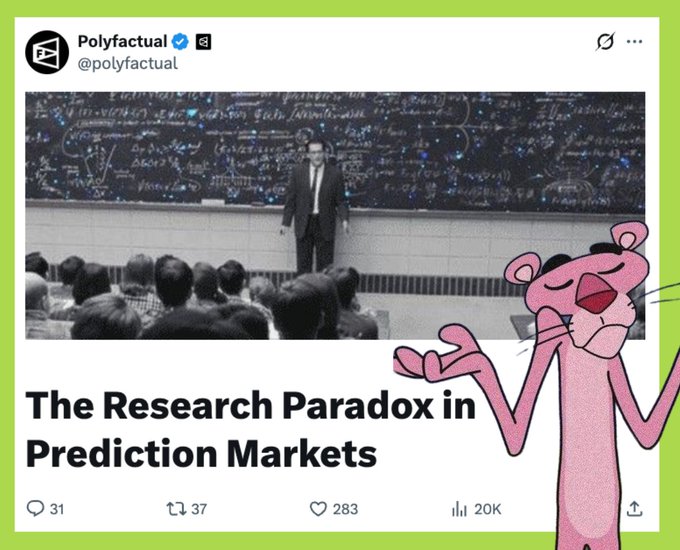
🔎 The Core Paradox of Prediction Markets: Pricing by Imperfection Prediction markets, in theory, should price probabilities across an extremely large space of states. Even a seemingly binary contract like "Candidate X wins" is actually conditioned by countless variables: macroeconomics, legal, media, funding flows, voter behavior… If there are n variables involved, then there exist up to 2ⁿ possible world states. However, prediction markets never fully price the entire space. Traders are limited by time, perception, and information, so they only choose a very small subset of variables to trade. Therefore, market price is not a "pure" probability, but rather the cost of buying exposure to a package of implicitly correlated scenarios, with a series of assumptions that are not isolated for pricing. More importantly, prediction markets are reflexive: price not only reflects reality but also impacts the underlying conditions – influencing media, funding, voter behavior, etc. This creates a feedback loop where belief and fundamentals are endogenously interconnected. 🚨 The paradox lies in this: - The market tends towards an impossible state-space to encompass. - But ignoring much of that space makes price both computationally feasible and capable of influencing behavior. - Exploitable inefficiencies often lie in the “forgotten tail” – valid scenarios that fall outside the narrative that most traders are paying attention to. This isn't a flaw, but a structural characteristic: prediction markets need asymmetry in research and belief to survive. If everyone understood things the same way, uncertainty would collapse into consensus, leaving no edge or reason to trade. Because it's impossible to list every 2/4 of the scenarios, traders are forced to compress information. In reality, most sentiment fluctuations are usually explained by a few key parameter classes: 📍Structural baselines – slow-moving fundamentals (partisanship, demographics, institutions). 📍Macro-directional indicators – macro-directional indicators that guide the overall narrative. 📍Catalytic events – highly elastic disruptive events (legal, scandal, geopolitical). 📍Behavioral & narrative priors – media, endorsement, money flow, voter sentiment. 📍Model-free momentum – price movements themselves acting as proxies for future possibilities. In short, the edge in prediction markets doesn't come from listing every scenario, but from the ability to identify the most effective layers of variables that compress uncertainty into narrative – where much of the market is missing. Source: @polyfactual - A market analysis and prediction channel with 14,000 followers.
This article is machine translated
Show original

Upside GM
@gm_upside
12-13
🔥Hệ sinh thái Polymarket đang mở rộng nhanh hơn nhiều người nghĩ
Từ một prediction market ngách nhỏ trong crypto, @Polymarket giờ đã phổ biến với rất nhiều người, dần trở thành một mảng sử dụng thật, có người chơi thật và dòng tiền thật trong crypto. x.com/gm_upside/stat…


From Twitter
Disclaimer: The content above is only the author's opinion which does not represent any position of Followin, and is not intended as, and shall not be understood or construed as, investment advice from Followin.
Like
Add to Favorites
Comments
Share
Relevant content