avatar
Murphy
64,409 Twitter followers
Follow
17年老韭菜;研究链上数据和宏观情绪相结合,构建自己的交易思维。保持谨慎乐观!| 近3亿用户的共同选择就在币安:https://t.co/5pQWuny9gU | #OKX web3入口一个就够 https://t.co/YwY7pIgKzB
Posts
Signal Clone Analysis
avatar
Murphy
How should we view the recent sustained net inflows into ETFs? ETFs have become the primary gateway for traditional capital entering BTC this cycle, serving as a clear reflection of market sentiment and demand shifts. Some friends have asked about the impact of these continuous ETF inflows on price action, so let’s break down a few key data points and details to watch: (Figure 1 – Spot ETF Net Flows) Figure 1: Both the rallies in October 2024 and April 2025 kicked off alongside strong, sustained ETF net inflows. In the past two weeks, the average daily ETF net inflow has been 1,710 BTC—this level is starting to look like the early stages of a new trend. But the crucial question is whether this momentum can persist and even accelerate. We’ve seen similar patterns in October 2025 and January 2026, but those fizzled out quickly because they couldn’t be sustained. (Figure 2 – CME OI & ETF Holdings Change) Figure 2: Remember, “ETF net inflows” don’t always equal “real spot buying.” There’s also arbitrage capital involved—buying the ETF and shorting futures to pocket the basis, which is a neutral play. Only when there’s a significant spot exposure between CME open interest and ETF holdings over a period of time can we confirm genuine spot demand—real directional buying. As shown in Figure 2, during this rebound, there’s a 31,078 BTC spot gap between ETF holdings and CME, which is a stark contrast to January 2026 when almost all positions were just arbitrage. This means over 60k BTC has actually been accumulated by real buyers starting to build positions, though it’s still not quite at the levels we saw in May 2025 or October 2024. (Figure 3 – Annualized Rolling Futures Basis) Figure 3: The 3-month rolling futures basis on Binance backs this up. In January 2026, the annualized basis arbitrage yield was 4.57%; now it’s only 2.92%, which doesn’t even compete with US Treasury yields. So it’s safe to say that most of the ETF net inflows right now are not coming from arbitrage funds. 🚩 TL;DR: Here’s what you need to focus on regarding ETF net inflows: 1. Can the net inflows continue and keep growing? 2. Watch the spot exposure to gauge how much real buying is happening. These will be the key factors determining how high and how far this rally goes—and could even impact how long and how deep the next bear market will be. twitter.com/Murphychen888/stat...
BTC
4.09%
avatar
Murphy
The BTC Accumulation Trend Score (ATS) assesses the relative balance changes across different wallet groups, assigning higher weight to larger entities, providing a useful reference for measuring on-chain "accumulation behavior." The closer the ATS is to 1 (black dot), the more likely large entities are to accumulate. Since February 5th, the ATS score has consistently remained below 0.5, indicating a lack of active accumulation behavior among holders. (Figure 1 - BTC Accumulation Trend Score) Especially during the rebound from March 1st to 4th, the ATS score dropped to 0.23 (light yellow dot), suggesting that some large holders began distributing during the BTC price rebound. Furthermore, we see that on January 14th, short-term holders transferred a total of 20,477 BTC to exchanges to lock in profits (more than on January 14th, 2026), reflecting STH's lack of confidence in the current market conditions. (Figure 2 - BTC transferred from STH to exchanges) Conversely, traditional capital, represented by "spot ETFs," played a crucial role at this time. The continuous net inflows from February 24th to March 4th absorbed some of the supply, creating conditions for a rebound (we will provide a detailed analysis of ETFs tomorrow). This indicates a strong divergence of opinion in the market; some are bearish and want to sell, while others are bullish and want to buy. The battle between bulls and bears is bound to determine a winner again. For us retail investors, we can only observe and wait for the situation to become clearer before making further plans. twitter.com/Murphychen888/stat...
BTC
4.09%
avatar
Murphy
Thread
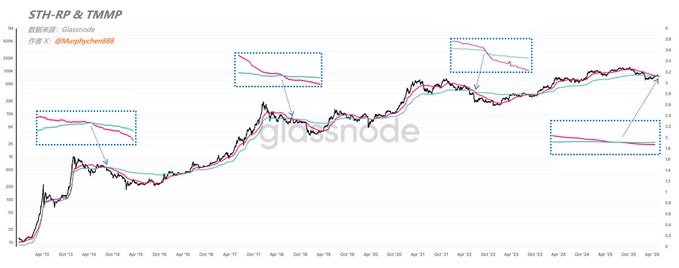
MVRV Extreme Deviation: The Probability Boundaries of a Bear Market Rally When analyzing bear market rallies on the daily timeframe, besides referencing the BRS signal, I pay special attention to the “MVRV Extreme Deviation Pricing Range”—a historically high-performing indicator based on past data. So, what are extreme deviations? In statistical terms, it’s the “degree of dispersion.” Under the assumption of a normal distribution, standard deviation corresponds to a probability range. Looking at the past 10 years of data: (Figure 1 - MVRV Extreme Deviation Pricing Range - Overview) 1. When BTC breaks below the yellow line, it signals the market entering the first phase of a bear market. After this, daily rallies rarely break back above the yellow line; if they do, it’s usually a minor and short-lived move—once confirmed, the trend continues down (see 2018 in the chart). 2. When BTC breaks below the green line, the market enters the second phase of the bear market. Again, rallies have a hard time reclaiming the green line until the bear bottom is in (see 2014 and 2022 in the chart). (Figure 2 - MVRV Extreme Deviation Pricing Range - 2026) On January 14, 2026, BTC rallied to $97,000, hitting resistance at the yellow line. At that time, our BRS signal had also returned to zero, further confirming this as a local top. Related post: x.com/Murphychen888/status/201...… (Figure 3 - Bitcoin Risk Signal) This time, the rally peaked at $72,691 on March 4th, coming extremely close to the green line, while the BRS hadn’t reset to zero yet. 🚩 My personal take: 1. Even if this current rally isn’t over yet, it’s likely very close to topping out. 2. My estimated top range is around $74,000–$78,000. But there’s one more scenario to consider: BTC still hasn’t broken below “<10y_RP”—the “BTC historical average cost basis” for coins moved in the past 10 years, which is a more realistic level. Related post: x.com/Murphychen888/status/202...… In other words, as long as “<10y_RP” isn’t lost, there’s still a chance for a “shallow bear” path. The special case to watch for: If BTC breaks strongly above the green line ($74,000) in the MVRV Extreme Deviation Pricing Range, and holds above it on any retests, then the probability increases that BTC has left the bear market bottom behind. That said, I think scenario 3 is less likely right now. Scenarios 1 and 2 are still the higher probability outcomes. (Reminder: This is just my personal opinion—nothing is 100%, always DYOR!) twitter.com/Murphychen888/stat...
BTC
4.09%
avatar
Murphy
Breaking news! ICE, the parent company of the New York Stock Exchange, has made a strategic investment in OKX, valuing the company at $25 billion, and has also acquired a seat on OKX's board of directors. This means that a core traditional financial infrastructure company has officially invested in a leading crypto exchage. According to multiple reports, the partnership between ICE and OKX is not just an "investment," but also includes significant business integration: OKX will provide ICE with real-time price data for the crypto market and plans to launch tokenized US stocks and derivatives in the second half of 2026. Users will be able to trade on-chain versions of NYSE-listed stocks on OKX, which is the most important thing. Meanwhile, ICE's strategic direction is clear: they have already been developing the infrastructure for tokenized securities trading this year. If this model succeeds, it essentially means that liquidity in the traditional securities market is beginning to migrate on-chain. In the future, the NYSE's competitors may no longer be just CME or NASDAQ, but will become crypto exchage, DeFi protocols, super apps, and so on. Conversely, if Tokenized Securities succeeds, OKX's positioning will change accordingly—it will enter the stage of a "super exchange" that integrates derivatives, stocks, and crypto. If ETFs represent TradeFi's integration with Crypto, then "tokenized securities" could be Crypto's first step in acquiring TradeFi in reverse.
Star_OKX
@star_okx
A New Chapter: Building the Next Generation of Financial Infrastructure Our partnership with Intercontinental Exchange marks an important moment for OKX and for the broader evolution of digital asset markets. ICE has built and operated some of the most important financial
avatar
Murphy
03-04
Thread
Based on the behavior of Super Whale, a BTC cycle phase analysis shows that they are at the top of the Bitcoin ecosystem food chain, with almost no natural enemies; they play a key role as the ruler and decision-maker in multiple cycles; and they are also the most powerful "smart money" in the entire class. They are not a single person or entity, but a clandestine group—Super Whales. According to Glassnode data, there are currently only 88 on-chain addresses holding ≥ 10,000 BTC. At its peak, there were 121 such addresses during the 2022 bear market. (Figure 1 - Number of addresses with a balance ≥ 10k BTC) They always manage to accumulate shares before the start of a bull market, and then distribute them over the time it takes to reach the top of the entire bull market. For example, at their peak in October 2020, they accumulated 2.47 million BTC, but by October 2021, they only had 2.02 million left. In 12 months, they completed the entire bull market top range, distributing 455,000 BTC. (Figure 2 - Total supply of Whale Wallet) In this cycle, their peak accumulation of tokens occurred in June 2024 (2.54 million tokens), after which the holdings continued to decline until reaching the lowest point in October 2025 (2.15 million tokens). This time, it took 16 months to distribute 392,000 tokens. The distribution period was longer than the previous cycle, but the total number of tokens was less. Now, this group has begun a new round of accumulation: as of March 2, their total holdings have rebounded to 2.26 million tokens. This is on par with (or even slightly higher than) their holdings in June 2022 (after Luna was exposed). From this perspective, based on Super Whale's behavior, we can judge that the current bear market cycle is roughly in the "middle" or "late" stage. Once they've accumulated enough capital, that will be the middle of the next bull market, after which another large-scale distribution will begin, and so on, in a never-ending cycle... twitter.com/Murphychen888/stat...
BTC
4.09%
avatar
Murphy
02-28
According to URPD data, 1.71 million BTC changed hands in the $63,000-$68,000 range. Just a week ago, the total supply in this zone was only 1.53 million, which means bulls absorbed an additional 180,000 BTC here in just 7 days. This forms a peculiar “U-shape” structure with the 1.89 million BTC stacked in the $87,000-$92,000 range, leaving the $71,000-$80,000 area as a clear “void zone.” It shows that during the last pump (October 2024), price just blasted through this area without consolidating, and on this latest drop, it sliced right through again. (Chart 1: URPD_2026.2.28) Back and forth, but never any meaningful consolidation in the $71,000-$80,000 range—it’s like this level has become some kind of “forbidden zone.” Honestly, this is next-level crypto voodoo—never seen anything like it before! But right now, the supply stack in the $63,000-$68,000 zone keeps getting thicker, signaling that there are plenty of buyers who believe BTC with a 6-handle is worth DCA-ing into. This creates a solid support base. With LTHs (long-term holders) distributing less, there’s a shot at BTC challenging that “gap” zone again. Below $63,000, the only major supply wall left is at $16,000, where 391,000 BTC still remain untouched since the last bear market bottom. Honestly, who really thinks BTC will revisit $16,000 this cycle? So, if $63,000-$68,000 gets taken out, there’s basically no clear support below—it’ll be up to the bulls to decide where to build the next defense. At that point, we might see a “W-shape” supply structure form, which would be a chart pattern for the ages! twitter.com/Murphychen888/stat...
BTC
4.09%
loading indicator
Loading..